Monthly Archives: August 2013

Simple Gifts

There’s a lovely Shaker hymn written in 1848 — “Simple Gifts.”  I’ve always loved the tune, and the words are just as beautiful as the tune itself:

“Tis the gift to be simple, ’tis the gift to be free

‘Tis the gift to come down where we ought to be,

And when we find ourselves in the place just right,

‘Twill be in the valley of love and delight.”

The first stanza is what looped in my head all day as I stayed home, alternately sleeping and reading.

What a joy it is to have the simple gift of a home itself, a sanctuary, a place of safety.  So many people don’t have the opportunity or the chance, and far too often we take our own homes for granted.  As I read through the news today, I was reminded just how fortunate I am.

The home itself, built in the 1920s, is a cottage or bungalow style, built on piers.  After all, in the coastal areas that architecture makes sense.  There are lots of large windows as well (and now they open, too, and have screens) so that breezes can circulate and cool the house.  Of course, in the heat of summer — which starts early and stays late here — it’s much more comfortable to use the air-conditioning.  In fall, though, as soon as the temperatures drop, it’s a treat to simply open a couple of windows and allow the breezes to circulate.

Because it’s older and on piers, some floors aren’t level.  Truly.  There’s an actual hump in the kitchen, right in front of the stove.  If I stand barefoot, my arch can actually curve to fit it.  Short of pulling the entire floor up and re-building, I’m not sure I can fix this.  Somewhere in the past, that board simply warped and settled.

Nor is the only such quirk in my home.  For years, before I discovered that there wasn’t a support beam anywhere from the living room to the back (and had one put in), the house wasn’t level — it was so not level that you could drop a tennis ball in the living room and watch it roll through the kitchen and the laundry room to the back room.  The house is more level now, and the floors no longer offer quite the fun of tennis-ball dropping.

It’s a modest home by many standards, but I fell in love with it as soon as I walked in the front door the first time.  The large windows in the living room allowed natural light to flood the room.  Since it’s a north-facing room, that’s really nice.  The bedrooms are east-facing, also nice for gentle light.

Over the years, I’ve added my own touches.  I’ve re-painted rooms.  I’ve renovated in earlier projects, but now am involved in yet more renovation.  Years ago my brother Phil pulled out the kitchen sink and lower cabinets and built new cabinets, neat and shelved and even put in some drawers.  About that same time I put down stick-tiles, but that wasn’t a wise choice.  These have popped and broken, and I am now in the process of beginning to pull them up.  New upper cabinets have been built and are soon to replace the older ones.  As those are done, one more coat of paint on the walls should do it.  Then I’ll get the lower cabinets repainted as well.  Finally, I want a new countertop and sink — I’m thinking of granite or quartz, something clean and simple.  Aqua walls above, white wainscot below — and aqua lower cabinets, white upper cabinets.  New flooring — sheet vinyl, probably, because of the uneven floor itself — will follow.

There are other areas I’m ready to work on.  The living room needs to have the old, crumbling paneling replaced.  The ceiling tiles there are falling down, so I’d like something simple to cover the ceiling.

For so long I too took this home for granted.  It was such a place of joy and comfort for a while.  Later, though, as my mother and brother were ill and after they died (in the 90s) it became more of a place to sleep, less of a home to entertain friends.

It was more of a refuge then.  On Fridays, I’d come home and shut the front door, often staying home all weekend.  Stressful work environment and life needed some kind of balance, and this house provided it.  I simply existed in it, though it did provide me that respite from the craziness of my life beyond it.

Then as Dad’s health worsened, I spent more time with him and less time here.  Moving in with him meant I was living in the bedroom I had when I was 16.  I moved essentials of my life there.  On weekends, I could visit my own home.  There wasn’t much time, however, for working on it or for actually living in it.

But that was interesting and revealing, too.  I learned about myself and how flexible I can be.  What is essential for me.  I occupy a house about 1800 square feet, and live alone (other than the three cats and two dogs).  Yet I have lived in a 12×13 ft. bedroom, with a small area in Dad’s living room for a computer desk.  And a card-table for a work desk.

Now I live in my home again and relish the opportunities to refresh it, to open it once more to friends.  I anticipate that.  I also recognize that such renovations will not happen overnight.  I have learned patience.  I have also learned, through living in Dad’s house while renovating it, to live in the midst of such chaos.  And to make order as I can, both mentally and physically.

Right now I am in the room that was once my bedroom, a room about 13 feet square.  Now it is an office, with no pretense at being a secondary bedroom.  I have my desktop computer and printer and my beautiful Texas-star-cornered black walnut desk.  My craft tables and materials are also in here.  As I sit here, I can look beyond the computer to a wall unit that my dad built me when I was in high school.  I wanted some kind of bookcase/storage/makeup area to fit my high-school status.  He couldn’t afford to buy the furniture but he built this piece for me.  It’s been painted since then but it has a pride of place wherever I am.

Much of my furniture, in fact, is a mix of family hand-me-downs and “store-bought” furniture.  Some was bought new.  Some was bought at flea markets or antique malls.  The blend works for me.

It’s not a house that will grace the pages of Southern Living or House Beautiful.  It’s not elegant.  My friend Patty says it’s “eclectic,” and she’s right.

I can sit in the large rocker in the living room, a gift from my grandmother Ella that belonged to her parents; I have the matching love seat too.  One of my earliest memories is sitting in that very rocker, then covered with red velvet I think, in my great-grandparents’ living room — and I’m so young that my feet barely reach the edge of the seat.

If I go to the kitchen and want to make gumbo, I use a pot that my grandmother Ella gave me when I moved to Beaumont to teach at Lamar University.  There are other pots and pans, of course, but that pot is one that is special.  If I want to make fudge, I use the bottom of a pressure-cooker that my mother always used, a pot that Mother gave me at some point.  We’ve made so much fudge in it that the line where the fudge boils up to is clearly marked if you look hard enough.

If I wanted to, I could sit on my front porch and watch people without fear.  I have neighbors I know well enough to wave to, to talk to, to visit with.

What a simple gift it has been today to stay home, recovering from sinus problems.  I could sleep without worrying that someone would break in or bomb me or use poison gas.  I could walk to the kitchen, open the refrigerator or freezer and find food with no problems.  Water from the tap was fine to drink.  A stove and microwave meant that I could cook.  If I needed, I could put laundry on to wash and then dry without leaving my home or without worry.  I had extra clothes, in themselves a gift.

I could talk to friends on the telephone or text them.  I could turn on a television or listen to music.

Television allows me to watch any number of programs.  Internet opens the world yet more to me.

My pets are fed and watered.  They are cared for, not wandering the streets searching for food.

And I can take antibiotics that my doctor prescribed and that a pharmacy filled, using health insurance I can afford, with a low co-pay.

Tomorrow when I meet a friend for early coffee (he has faculty meetings tomorrow since McNeese State University’s fall term begins on Monday), I have a car that I can depend upon.

These are gifts, gifts from the work I did for years, from the savings I have, from the pension I’ve earned.

I am surrounded by gifts, gifts from loving family and friends.  Gifts from my own work. Gifts from opportunities for women that don’t exist in other parts of the world.  I went to school and was able to make teaching literature and composition my career.  I can travel without permission from my male relatives.  I can make my own financial decisions, sign my own legal papers.

Simple gifts.  Gifts to cherish.

Today was a good day to be grateful.
Categories: Uncategorized | Tags: , , , , , , , , , | 2 Comments

Rainy Day Occupations, McDonald’s, and Playing with Fire

The torrential rains today made me glad to be inside, safe and dry, even if I was at McDonald’s.  In the kid’s playground area.  

I’d driven to meet my friend Myra and it’s convenient to meet her there so that her three-year-old son has much to occupy him.  Myra and I play together too — making jewelry, talking about jewelry, and just talking in general.  We’ve talked for years about finding the time to do this kind of thing.  Now that she’s not working (though Lord knows taking care of a three-year-old and a 17-year-old is work), she has time, and I’m retired.  Perfect for finding time to make jewelry.

It’s not as though we couldn’t do it at home, individually.  Sometimes, though, it’s fun to be involved in crafting (or whatever) with a friend.  Ideas can be sparked by something the other person says or makes.  Another set of eyes can make a huge difference with a design or selection of stones.

Besides, it’s just fun.  And too often we forget as we are all involved in being adults that play is such enjoyment. We know that as children.  Remember the absolute glee with which you once threw yourself into some game or project when others were involved?  

So it’s not too strange, after all, to see a 40-something and a 62-year-old in a McDonald’s playroom with all their “toys” on a table, chatting away, laughing, and stringing together stones and beads with wire.  We fit right in with the two- and three-year-olds in the same area who are scrambling around the various objects, squealing with delight, climbing up into the tubes, and sliding down.  We’re just a bit more . . . adult. . . about it.

The rain made such a perfect setting for a playdate.  It was rather gray and drab outside, dark at times — and that was before the deluge hit.  Torrents of rain fell so fast that the streets flooded in areas.  There was at least a small break in the rain when Myra and her son arrived, so by the time it started up again we were already hard at play.

At times, I admit, our jewelry get-togethers turn out to be more like talk-fests.  We jabber away and our hands don’t work too much.  Those times it seems that the jewelry is just an excuse.  After carefully unloading our various boxes and bags of gems and stones and other beads, our wires and tools, we sit and talk more than anything else, but today wasn’t like that.

It was in fact a pretty productive day today, even though we chattered away.  Myra’s been working on bracelets, something I’m interested in but haven’t really tackled yet.  I keep meaning to, but my hands end up making earrings.

Which may not be that surprising, actually, to a number of friends.  I am, I confess, an earring junkie.  I collect earrings.  Long, dangly ones.  Hoops.  Small single stone studs.  And I wear multiple earrings since I have multiple piercings — four on my left earlobe and three on my right.  

Colors and stones and wires just want to get made up into something that I can imagine wearing.  That’s the problem, too.  I want to keep a copy of almost everything I end up making.  Or I give them to friends.  Or to my sister.  These, I cleverly label as “prototypes.”  Sounds good, right?  

So today I kept working on variations of a dangling earring design I came up with — involving one or two types of gemstones, of a couple of sizes, with sterling silver beads, strung on sterling silver wire that is in turn wrapped up and around the beads.  Sometimes I add a little Celtic swirl of wire.  Then I finish the earrings off with sterling silver French wires.  

This week’s near-frenzy of earring-making was set off when a friend asked if I could make her something with lapis and other blue stones.  I experimented.  I ended up with three variations just of lapis and apatite, lapis and blue chalcedony, and lapis and turquoise.  Then I expanded to ruby and pearl and citrine drops.  And emerald and aventurine.  I made at least two pairs with each design.

Fiddling around with some other beads today after I’d coiled enough wire to make my fingers hurt, I decided to use some lapis hearts I’d been hoarding.  Four pairs later, I had strung together a pearl, a lapis bead, a sterling silver bead, and the lapis heart, ending with a Celtic-like swirl of wire.  Finished off with French wires, the first pairs are complete.

Some weeks I don’t do much at all.  Now that I’m on a roll, I hope to continue a day or two a week, especially if Myra and I can get together.  I’ve discovered that if I keep some materials handy, in a bag or two in my car, I can pull them out at Starbucks or McDonald’s even if no one else is with me and happily spend an hour or two crafting away.

This is a perfect occupation for a rainy day like today.  With all of the water flooding the streets and the rain pelting people who had to get someplace, I had no desire to be anywhere else.  At least, not to get outside while it was still raining. By the time the rain had stopped, and Myra had to go to pick up her 17-year-old from school, I was ready to go home.

By then, the fact that McDonald’s playroom was cold enough to hang meat in had taken its toll — and I felt frozen and achy,  as though I’m trying to come down with a cold.  I simply came home, put on my nightgown, and crawled into bed in the middle of the afternoon.  I can do that now, happily, without fear of missing class or anything.  I read for a while.  I had bread and cheese.  I napped.  I went on to Facebook.  I read.  I napped.

That’s the beauty of rainy-day time.  The freedom to play with friends, to read, to sleep as the sound of rain soothes me.

In all the years I’ve worked, I’ve dreamed of time for various crafts and hobbies.  Now that I’m retired, I’m indulging in trying them out.  My friend Connie and I took a watercolor collage class.  Myra and I make jewelry.  I’m prepared to try to make soap soon.  To repurpose furniture.  

Clearly, I watch way too much HGTV and other channels with shows about home improvement and crafting.

Hobbies, though, are so important, so necessary.  Maybe we adults call them “hobbies” so that we can dress up what we’re really doing — playing.  It sounds more responsible somehow.  

But whatever you call them, hobbies keep us involved, make us think, produce things, and entertain us.  They’re our outlet to the playground fun of childhood.

So I look around and think of all the jewelry projects I’m working on, about the projects I’m ready to try in new crafts.  New outlets, new experiences. Expansion.

Other projects are ready for me — not just jewelry.  I’ve got a writing project to start, one for a small company.  I’ll be writing a history of the company, and first I’ll have to sort through lots of photos.  Maybe that’s something I’ll work on tomorrow.

Of course, there’s always the attraction of something new to play with.  Myra and I both were talking about the need to move on to soldering, something that will expand what we can make.  We laughed about it to a friend of mine who wandered into the playground today to talk, and each of us confessed to her that we had equipment and tools we’d not yet used. 

So we promised each other — soon we’d make a playdate just to work with soldering.  Of course, I want her husband there to guide us — he does know how to solder, though not with jewelry.  I figure having some (other) adult there with actual knowledge can’t hurt.

Oh, and I think it might be a good idea if he has a fire extinguisher.  

We’ll be playing with fire, after all.  

Categories: Uncategorized | Tags: , , , , , , , , , , | Leave a comment

The Blue Light Special

I never thought I’d get experienced at planning funerals, but somehow I’ve done that.  Three times I’ve worked on arrangements for family (mother, brother, father).  Once I helped a friend make the plans for her mother-in-law, going to the funeral home with her and walking her through the process.

It’s a strange experience to say the least, and none have been alike.

My mother’s funeral was the first.  By the time Mother died, we’d had several close calls, and the first one of those was when Dad turned to me and said something like “This is where you’ll have to help.”  The problem for him was that while he knew where Mother wanted to be buried, he had no clue about how to go about planning her service.  You see, she wanted to buried in the small cemetery connected to Antioch Church of Christ near San Augustine, Texas, where Dad’s parents are buried, as well as many of his relatives.  Mother, however, was Roman Catholic.

Their marriage in 1948 had been in a different era, when Catholics and Protestants weren’t allowed to marry in the church itself.  Instead, Mother and Dad married in the priest’s home and a small reception followed at the home of my Grandmother Adair and her husband.  By the time Mother died, in 1993, many things were different.

But Dad was still clueless when it came to what she’d want, to what her family would expect.  I talked to a priest about her desire to be buried in a Protestant cemetery, with a Church of Christ minister at the graveside, and he said there’d be no problem. As I told Dad, her family would just have to accept that.  On the other hand, his family would have to accept that we would have a rosary, a visitation, and a funeral mass at the funeral home in Crowley, Louisiana, prior to the burial.  He was relieved, I think, that I had dealt with this angle of her funeral and burial.

It was several years, however, before we actually had to follow through with the plans.  Mother died very quietly at Lady of Lourdes Hospital in Lafayette, Louisiana, early in the morning after my brother Phil had arrived from Florida, where he lived and worked.  I’m certain she was waiting for him before she left us.

Dad and Phil were with her; they’d stayed in the hospital with her.  I’d stayed most nights until then, and Kay and I were in Egan.  So that very morning, we went with Dad and Phil to Geesey-Ferguson Funeral Home in Crowley to make arrangements.

We sat and talked with the funeral director.  I started writing the obituary –another thing I could relieve Dad of handling.  And then we were brought to another room, one filled with caskets, to make a selection.  That’s when the surreal element kicked in.

One thing I have in ample quantity is a sense of humor.  Perhaps it’s a bit warped at times, but it’s mine.  And Kay often shares it, as she did that day.  Dad and Phil were off in one part of the room, solemnly examining one casket after another.  Kay and I were wandering in another area, looking at various caskets and then at the notices/prices on each.  One was on special, and I leaned over to Kay and whispered “Attention K-Mart Shoppers.”  Suddenly, we realized that we were both caught by a particular absurdity on one label:  “Life-time Guarantee.”  Excuse me?  Just how does that work?  It was all we could do to restrain ourselves from laughing right then and there.  We’ve done it since, and often, and all I need to do is say the magic words:  “Attention K-Mart Shoppers” — she understands exactly what I’m referring to.  

Dad and Phil never heard us.  We joined them in a much more solemn discussion of which casket to pick out.  Phil really did the selection — a pinkish hue that would be as close to Mother’s favorite color (red) as we could get.  Done.

We’d also brought makeup, nail polish, and clothes.  Mother had a white pantsuit and red blouse (of course!) all picked out and set aside.  She’d never forgive us if we didn’t send her off in style, complete with beautifully done nails and red lipstick.  The polish helped, of course, in hiding the yellowed, cracked nails that were the wrecks of her once-elegantly manicured hands.  Later, Phil and I went out to find a scarf to hide the many bruises on her arms since her blouse and jacket were short-sleeved.

Later as we had the rosary, I met friend after friend, relative after relative, and walked with them to her casket.  I found myself saying that yes, she looked good, all the while fussing at myself silently for falling back on the cliches.  Yet what else was I to say?  

We’d lived in Egan since 1957, and my mother’s family ties were there long before that, so between relatives and friends, from Dad’s Sun Oil co-workers and our school friends, there were a lot of people.  I told someone later that I felt like a social director to the universe.  And I guess that’s what got me through it.  It gave me something to do, to focus on, and I could see the grief and weariness in Dad’s face and Phil’s and Kay’s.  Mine was there too, but Mother knew and expected me to step up and keep things on keel.

The next day, we had a funeral mass in the chapel before heading to Texas.  I’d picked out only one hymn, “Ave Maria.”  It was one of Mother’s favorites, and I can still hear her lovely alto voice singing it.  The four of us and Kay’s family sat on the first row, holding hands and trying to hold it together.  Around us were Mother’s sister and her family, and Dad’s sister and her family, along with my dad’s aunt and her family, and Dad’s sister-in-law and family.  I had friends from Lake Charles.  There were so many Sun Oil friends, our other family. It was a full chapel, a real delight to see.  As I  walked out that day, I remember seeing my cousin Carolyn, my mother’s niece, who is more like my older sister than a cousin, and when I saw her I just lost it.  I also vividly remember my friends’ shocked faces at that sight.  I guess they’d not seen me break down that way before.  But I recovered, and we got through the rest of the day.  After going to Egan, Dad and the rest of us went to Texas, for the second part of the services.

There we simply went to the small church that sits near San Augustine, the county seat of San Augustine County.  Antioch Church of Christ is the oldest Church of Christ church in Texas, if I recall correctly.  The graveyard is in fact on land that my great-grandfather William Henry Richards donated.  We were met by the preacher, a family friend, and had a very touching graveside ceremony.  Then we went to the farm, just down the road, and had coffee and food for visitors.  By the end of the day, I was so exhausted that I almost fell asleep lying on the front porch.  It was the end of July, and it was hot.  We only have one window air conditioner in the house, in the living room, and believe me, it wasn’t enough.  At some point, my cousin Mike’s wife came out in her shorts, announcing that Mother would understand.  I had to grin at that one.  She certainly would.  She hated to sweat.

We’d survived.  That was good.  

In January 1996 we were back in the same cemetery, this time for my brother Phil.  Phil died of cancer (his fourth round) and had drilled me for three months on what he wanted and didn’t want.  I had to repeat the drill every weekend that I was at MD Anderson with him.  As confused as he was, he was clear that I had to follow his wishes.  He was adamant:  he wanted to be cremated, and he wanted to be buried at Mother’s side, and he did not want a funeral.  And we followed his wishes, mostly.

It was a cold, damp, wintery day when we drove in from Egan.  Phil’s fiance Darcy and Kay and I and Dad drove in for the day only.  Each of us women held the box of ashes at different times.  I still remember the shape and heft of that plain white cube, and wonder at holding it.  

Texas has no restrictions on burying ashes.  Thus we simply went to the farm so that Dad could get a shovel.  Then we went to the cemetery.  Dad dug the small opening.  We had family members with us — not a huge group, just the immediate family.  I read the psalm that I’d read frequently to Phil in the hospital.  I had always liked it, and Phil came to request it a lot.  So I felt safe in reading it.  If you’re not familiar with it, here it is:

Abiding in the Shadow of the Almighty
1  He that dwelleth in the secret place of the Most High

        
shall abide under the shadow of the Almighty.
2  I will say of the LORD,

        
He is my refuge and my fortress:
my God; in him will I trust.
3  Surely he shall deliver thee from the snare of the fowler,

        
and from the noisome pestilence.
4  He shall cover thee with his feathers,

        
and under his wings shalt thou trust:
his truth shall be thy shield and buckler.
5  Thou shalt not be afraid for the terror by night;

        
nor for the arrow that flieth by day;
6  nor for the pestilence that walketh in darkness;

        
nor for the destruction that wasteth at noonday.
7  A thousand shall fall at thy side,

        
and ten thousand at thy right hand;
but it shall not come nigh thee.
8  Only with thine eyes shalt thou behold

        
and see the reward of the wicked.
9  Because thou hast made the LORDwhich is my refuge,

        
even the Most High, thy habitation;
10  there shall no evil befall thee,

        
neither shall any plague come nigh thy dwelling.
11  For he shall give his angels charge over thee, Mt. 4.6 · Lk. 4.10 

        
to keep thee in all thy ways.
12  They shall bear thee up in their hands,

        
lest thou dash thy foot against a stone. Mt. 4.6 · Lk. 4.11
13  Thou shalt tread upon the lion and adder:

        
the young lion and the dragon shalt thou trample under feet. Lk. 10.19
14  Because he hath set his love upon me, therefore will I deliver him:

        
I will set him on high, because he hath known my name.
15  He shall call upon me, and I will answer him:

        
will be with him in trouble;
I will deliver him, and honor him.
16  With long life will I satisfy him,


and show him my salvation.”

I read it using he New Testament that Grandmother and Granddad Ware had given me on my 7th birthday. Yes, I grew up reading the King James version of the Bible as well as the Douay-Rheims Bible that Mother had.  And this psalm still comforts me.

After I read the psalm, Dad simply covered the small grave opening, and that was that.  We went back to the farm briefly, for coffee and refreshments, but didn’t stay.  It was far too cold, and we were exhausted.  We drove back to Egan that same day.

Somehow I never got my New Testament back.  Dad kept it on his headboard for the rest of his life.  Only after he died did I retrieve it.

When it was time to plan Dad’s funeral, Kay and I had no real problems.  We’d talked about it, made choices and decisions, and knew what we would do and what Dad would want.  

Dad died at home, very peacefully, simply drifting off in his sleep.  Kay and I sat there in the living room with him, waiting for the friends we’d called, and soon Billie and Charles were with us.  We waited for the hospice nurse, and then for the crew from Geesey-Ferguson Funeral Home in Crowley.  When the crew came, it was led by one of my cousins, which was so touching and comforting.  

Later that morning, Kay and I went in to begin the process.  Since I had power of attorney, I had to sign things, had to handle the paperwork and finances.  But Kay and I made all the decisions together.  It was pretty straight-forward.  We’d have a small gathering there in Crowley for friends and family and Dad’s former co-workers from Sun Oil.  Then we’d have the funeral in Texas, in San Augustine.

As with Mother and Phil, I wrote the obituary.  Once more, I could use my abilities to serve my family in some small way.  Searching out what was important, what I wanted people to remember, what would speak to Dad’s personality (or Mother’s, or Phil’s) — that allowed me to honor each of them.

Selecting the casket this time was easy.  Kay and I had exactly the same ideas, and found a beautiful wood casket.  In looking at the possible additions, we grinned when we saw that there were small deer heads with antlers for the casket corners.  Yes, that was perfect — Dad the deer-hunter would like that.  

Selecting music and photographs for the memorial DVD (a new twist since our previous funeral planning adventures) took some time, but again proved how much Kay and I were on the same page.  No problems.  

The visitation went well.  Again, because we’d lived in Egan since 1957, there were many people whose lives Dad had touched, and he was clearly well respected and loved.  There were older people, men Dad had worked with.  There were neighbors.  There were people we’d gone to school with, guys my age who’d been on the baseball teams Dad coached.  

We drove to the farm.  Dad’s sister and sister-in-law and their families were with us.  The funeral home in San Augustine was packed.  My mother’s niece Carolyn and her husband came — no surprise.  When a friend of mine from Houston came, though, I was touched — he is a young man I’ve known since he was barely out of middle school, a former student now an attorney, and his effort to be there meant so much to me.

We sang the hymns we’d selected, hymns we’d grown up hearing Dad sing in his baritone, hymns we’d sung along with.  I’ve never been so aware of loss as then, I think.  But not just for me.  For my aunts, my dad’s sister and sister-in-law.  My dad’s sister, in particular, broke my heart.  As a sister who’d lost a brother, I found myself identifying with her in ways I’d never done before.  

There were lots of tears that day at lunch following the graveside rites, and at the farm after that.  But there was also tremendous laughter as we sat around and told stories.  

That’s really the healing, I think.  The tears, certainly, because they cleanse us somehow, releasing sorrow and anguish and grief, at least for a while.  They will come again, and again, but that first communal tear-fest (if it can happen) allows for much-needed relief.  

And the laughter?  Why not laugh?  Why not be joyful?  And so thankful for all the wonderful times.

As we sat there that day, we told stories about Dad and also about Phil and Mother.  Silly things, funny things.  That Mother could talk like Donald Duck (but we didn’t know what she was saying for years until she told me — “Son of a bitch!”) — and laughing about the first time she did that after she got her dentures.  We all tried our best to sound like Donald, and then Mother opened her mouth and the top dentures nearly flew right out!

Or about the time Phil and Mike and Sis and friends were fishing down in the pond, and one of them cast the fishing hook right into Phil’s scalp.

Or how when we were kids we’d run all over the farm, and how Grandmother always knew when we’d been where we weren’t supposed to be.  

I don’t think we ever think about funerals when we’re young, certainly not about planning them.  But as we get older, we go through funerals and begin to assimilate all of the cultural baggage that accompanies them.

Mourning rituals in other cultures offer the grieving family and friends some pattern to follow, some designated form and time for formal mourning of loss.  Our own culture, it seems to me, has in many ways distanced itself from mourning.  Once the funeral’s over, we’re supposed to have “moved on” and “beyond” it somehow, almost immediately.  Talking about the person who has died often makes people uncomfortable.  

Yet how realistic is it for us to simply cut that person out of our life, out of our memories?  Isn’t it much better to remember them and enjoy those memories?

And as we age, too, I guess, we find ourselves moving to the head of the class, so to speak.  For as our elders die, we move up.  Where they were the family memory-keepers, we take over.  And we must, inevitably, think of our own mortality.

One friend of mine lost her husband to cancer a few years ago.  She had a memorial service for him, playing his favorite music, and friends sat around and told stories.

That’s what I want.  A party.  I’m already working on the music list.


Categories: Uncategorized | Tags: , , , , | Leave a comment

Music Lessons, Guy Clark, and my Randall Knife moments

I’ve written before about music and its importance in my life.  From road music to house-cleaning music to relaxing music and grading music, somehow music always seems to sneak into my life.

Today it popped in as I was reading CNN on line and clicked on a link I saw about “True Love and Homegrown Tomatoes.”  Though the link was to the Eatocracy page of the site, I just knew what I’d find.  I wasn’t disappointed.

Though the focus was indeed on the deliciousness of home-grown tomatoes, the source of the title was clear to me:  a Guy Clark song long a favorite of mine.  Clark wrote this in 1983, a warm, funny Texas take on a Southern favorite — homegrown tomatoes. His lyrics celebrate the down-home lusciousness, the very ordinary homegrown tomato.

“Ain’t nothin’ in the world that I like better
Than bacon & lettuce & homegrown tomatoes
Up in the mornin’ out in the garden

Get you a ripe one don’t get a hard one
Plant `em in the spring eat `em in the summer
All winter with out `em’s a culinary bummer
I forget all about the sweatin’ & diggin’
Everytime I go out & pick me a big one.”

With the first lyrics, I am transported back to childhood, to my dad’s garden, to picking tomatoes right off the vine and biting into them, juice dribbling down my chin.  Or to the simple presentation of thickly sliced tomatoes on a plate, sprinkled with a bit of salt.  Or even just slapped between slices of mayonnaise-slathered bread with lots of pepper and a bit of salt.

Yes, Clark’s got it right.  Nothing better than homegrown tomatoes — one of two things money can’t buy:

“Homegrown tomatoes homegrown tomatoes
What’d life be without homegrown tomatoes
Only two things that money can’t buy
That’s true love & homegrown tomatoes.”

He even jokes about how he’d like to end up:

“If I’s to change this life I lead
I’d be Johnny Tomato Seed
`Cause I know what this country needs
Homegrown tomatoes in every yard you see
When I die don’t bury me
In a box in a cemetary
Out in the garden would be much better
I could be pushin’ up homegrown tomatoes.”

One of my favorite Texas singer-songrwriters, Clark manages to write about so many ordinary moments in life.  The whimsey of “Homegrown Tomatoes,” a light-hearted look at the joys of food, gives way to other songs touching on memory and loss,.  Two of his songs bring me tears every time I hear them:  “The Cape” and “Randall Knife.”  Both of them take me to childhood, to family, and to the adult’s retrospective look at what’s been lost.

Growing up the 50s and loving Superman both on television and in comics, I was one of who knows how many kids who tied bathroom towels to my shirt and hopped off of steps, pretending I could fly.  The sheer fantasy of freedom, of flying, somehow faded with growing up, though flying dreams persist to this day (don’t go Freud on me).  So when I heard Clark sing “The Cape,” all of that joy rushed back.  Clark’s “boy” jumps off, falls to the ground; and “All grown up” he’s still at it, “pretty sure he could fly.” Even “old and gray” he’s still at it, “He’s still jumpin’ off the garage/ And will be till he’s dead/
He did not know he could not fly /So he did.”

The chorus reiterates what this song brings to me every time I listen to it:

“He’s one of those who knows that life
Is just a leap of faith
Spread your arms and hold your breath
Always trust your cape.”

That leap of faith, taking off and leaping, and trusting your cape. How often we grow up and grow out of that sense that we can do anything.  Fear holds us back, holds us down.  Remembering to trust the cape — that’s key.

Where “The Cape” takes me to something we often lose as we grow up, another song takes me back to being a child with a father to being an adult dealing with the loss of a father.

A tribute to his late father, “The Randall Knife” appeared in 1983.  The lyrics evoke both the child’s experience with the knife and the adult’s association of the knife with his father.

“He let me take it camping once
On a Boy Scout jamboree
And I broke a half an inch off
Trying to stick it in a tree
I hid it from him for a while
But the knife and he were one
He put it in his bottom drawer
Without a hard word one.”

Though the father never rebuked the son, it’s clear that the memory lingered for the son:

“There it slept and there it stayed
For twenty some odd years
Sort of like Excalibur
Except waiting for a tear.”

As an adult, the son sings of the loss of his father, of not being able to cry, not because of lack of love but because he wasn’t quite ready somehow.  And that his father deserved something better:

“And I couldn’t find a way to cry
Not because I didn’t love him
Not because he didn’t try
I’d cried for every lesser thing
Whiskey, pain and beauty
But he deserved a better tear
And I was not quite ready.”

Years later, the knife long forgotten in the drawer, the son looks back at the loss of his father, adding the perspective of yet more years between his father’s death and the song itself.

“My father died when I was forty
And I couldn’t find a way to cry
Not because I didn’t love him
Not because he didn’t try
I’d cried for every lesser thing
Whiskey, pain and beauty
But he deserved a better tear
And I was not quite ready.”

Later, when asked what he wanted to remember his father by, the singer continues:

“When we got back to the house
They asked me what I wanted
Not the lawbooks not the watch
I need the things he’s haunted

My hand burned for the Randall knife
There in the bottom drawer
And I found a tear for my father’s life
And all that it stood for.”

Long before my father was ill, long before he died, this song moved me to tears, but afterwards it just reduces me to puddles.  As Kay and I have gone through decades of Dad’s life, I kept discovering things that, like the Randall knife of Clark’s song, weren’t really much in themselves but somehow embodied the man who owned them.

I’d certainly cried many times before the loss, as well as during the months of watching my dad simply disappear in so many ways before my eyes.  Yet throughout I kept seeing my dad over time, as the young father who helped me, who admonished me, who tried to show me the honorable way to live with others.

Being a girl, I was never allowed to hunt with my older boy cousins or my younger brother.  Yet Dad made sure I knew how to handle the guns we had.  And while I might never use them in the same way, they are a reminder of something he held dear.

Some of the guns were his father’s.  One in particular — a pearl-handled pistol that Granddad Ware carried during World War II when he was a guard at the shipyards in Beaumont.  Dad had promised that gun to his nephew Charlie, and in May Kay and I got that gift to him.  Now we’re trying to figure out other gifts for the other boys in the family.  A few years ago, Dad gave my brother’s deer rifle to my cousin Barbara’s son James — James and his own father, Herb, had hunted together for years, and Dad though that Phil would like another young man to keep the tradition up.  Another gun needs to be selected for my cousin Mike, Charlie’s brother (their mother is Dad’s older sister).  And yet another for Jim, Barbara’s brother (their dad was my dad’s older brother).

Right now, I’m cherishing a 12-gauge shotgun that was Granddad’s.  And Dad used it too.  More than I can handle, probably, with a heck of a recoil, as I remember Dad saying, and as many others have warned me.  Yet the gun itself — made probably around 1902– is so much more than it appears.

It’s a link between generations, a clue to something about my dad and his dad, to the ties that link us together as family.

I’m a liberal with a gun.  When I went to the Antiques Roadshow in Baton Rouge last month, I took two items — both family heirlooms.  I brought a small dinner ring that had been my mother’s and her mother’s — a 1930s Art Deco ring, 14-caret yellow and white gold, 3-tiny-diamond ring.  It’s precious to me because it links me to them.  I can imagine my grandmother Ella wearing that ring.  It has a story, too.  She didn’t buy the ring; she wasn’t given it as a gift from a boyfriend or a husband.  While she was a single mother with two daughters to take care of, Grandmother ran a boarding house in Beaumont.  One of her boarders couldn’t pay rent at some point, and thus the ring came to my grandmother.  For me, it’s a symbol of a woman who was taking care of her daughters, who was a businesswoman and a stylish woman.  That ring is one I wear a lot.

The second item?  I brought Granddad’s 12-gauge Winchester 1897.  When i took it out of the soft case, four or five men swarmed around me, admiring it, knowing exactly what it is.  One of them showed me that it wasn’t frozen, that it racked just fine.  I must admit that the sound was quite nice.

How much more Southern girl can you get?  A 12-gauge shotgun and a diamond dinner ring.

And so my Randall knife moments.

Guy Clark does it to me every time.  From making my mouth water for freshly sliced homegrown tomatoes (or unsliced ones right off the vine); to reminding me not to forget that life’s a leap of faith, to trust the cape and just jump; to making me cherish the Randall knife moments of a child missing her father.

When I finished reading the CNN piece, I thought immediately that I knew what I wanted to write about — all the Texas singer-songwriters who have woven through my life.  I never got past Guy Clark, however, and that’s okay.  There are many other days to write about those other fine artists.

Today, though, is a Guy Clark day.  Specifically, a three-song Guy Clark day.

I ended up searching YouTube for each song, and I’ll pass those links along to you.  If you’re not familiar with Clark, take time to listen.  You might be surprised.

“Homegrown Tomatoes” :  http://www.youtube.com/watch?v=1-QzLIjL1u4

“The Cape”  :  http://www.youtube.com/watch?v=T6bZ37nexSY

“The Randall Knife” :  http://www.youtube.com/watch?v=KY5MOUO464Q

Yes, Guy Clark sings of the most ordinary items, the most ordinary memories, and the most common of experiences — and I can only recommend that you give him a listen.

Categories: Uncategorized | Tags: , , , , , , , , | Leave a comment

Surprising Saturday . . . Sleep and Goals

Somehow I missed yesterday altogether.  Though I woke up and dressed and pulled the covers up on my bed, I then lay down to read.  I was expecting a text from the guy who works on my house, but didn’t get any messages.  I did get one from a friend who was coming over to work on jewelry.  She wasn’t able to come.

Other than that, my day was spent sleeping.  I mean all day.  At noon, I made a peanut butter sandwich.  I remember lying back down afterwards, reading a bit.  Periodically I’d awaken, check email and FB, and then simply blink back down to sleep.

And then it was 11 at night.  I woke up, checked the time, put on my nightgown, and settled down for more sleep.  I’d been drowsy all week, not able to sleep well, and without energy.

Thus the necessary day after — the day when my body simply shut down to recover.

At no time did I even get up to work on the blog.  I have no real memory of even thinking about it.

Once in a while, one of these days hits me.  Only on Wednesday night did I realize that my chronic sinusitis had clicked in and that the histamine build-up was overwhelming me.  Since my doctor is out on Thursdays, I had to wait until Friday to see his P.A.  That visit, complete with cortocosteroid shot, made my day complete in that I knew I would soon have the boost of energy I needed, the medicines for combating the infection and cough, and would thus be back on my feet.  I forgot, though, what usually follows such a shot — the inability to sleep, the consequent sleepless night.    By Saturday, I guess, my body was just reacting to the jolt of sleeplessness that always accompanies those shots.  I didn’t even get out of bed when the pharmacy called yesterday to tell me that my medicines were ready.  I slept.

So today, reluctantly, I have finally awakened to the world again.  Reading the newspapers in bed — always one of my daily enjoyments — is mostly over.  I haven’t finished reading The Sunday Times, but that will be my treat for later.

Despite my disappointment over failing to post a blog post yesterday, I guess it was bound to happen.  I’d miss a post.  My goal is to write and post daily, yet I have already broken that goal.  I’ll live, but I’m not letting myself get away with this.  I am more determined than ever to keep my goal as much as possible.

Why?  Well, there’s no real “need,” is there?  No paycheck depending upon it.  No being written up for failing to meet class.

There’s just the desire — perhaps even the need — to establish a routine of sorts for myself in retirement.  I don’t want to be one of those lost pensioners who simply sit and do nothing.  For many years I’ve planned on an active retirement — traveling and writing and visiting friends, puttering around my house more.  Having freedom to set my own schedule and projects rather than having them set for me.

So my failure isn’t something others have defined — it’s something I perceive and regret.

At the same time, it makes me remember the realities of life — those times when illness or something else interrupts our schedules.  While goals are fine, I have to accept that they are self-imposed.  And that there will occasionally be hiccups.  As in yesterday.

Today, then, I awoke to realize my Saturday lost to sleep and recovery, while enjoyable and necessary, also left a hole in my life.  I’ve come to enjoy the daily writing routine, and I missed it yesterday.

A new discovery in the ongoing adventures of post-retirement life, certainly.  While I certainly have more freedom in setting my schedule and projects now, I am still dependent on others’ schedules — as with my friend who had problems and couldn’t get here, and with the guy working on my house.  I no longer have to set an alarm clock and be out of the house every day to meet classes and office hours and committee meetings, but I do have appointments and coffee-shop visits, shopping and errands, and out-of-town responsibilities.  The alarm clock is still necessary.

Those appointments and meetings and visits are just spread out and no longer confined to hurried weekends and afternoons after work.  They’re interspersed with my own daily routines.

How to balance it all now in this new time of life — and that I’m still exploring and discovering just what my life is to be — that is my continuing challenge.  Yesterday just made me conscious that “the routine” is flexible, constantly in flux, that once “discovered” won’t be set in stone either.

Discovery, recognition, goals made and goals not met — balance.  Shaking off disappointment and getting on with my life.

Saturday was surprising, but necessary.  Not just in terms of needed sleep and recovery from the sinus infection and shot, but also in time for me to face a reality about post-retirement, about goal-setting and failure to meet goals.

With some goals, you can’t necessary make up what’s not met.  With writing, though, I can figure out ways to cope.  I’m sure I’ll face more challenges about meeting the daily writing goals as I start to work on other projects — the short writing project I have a meeting for tomorrow, the planning of a syllabus for a three-week library program I’ll be conducting in November, and writing in other on-going pieces and poems.

But regarding the blog, I’ve got it figured out already — I’ll write a couple of posts at a time, simply creating a small bank.  For now though –I’ll just write a second post tonight!

Categories: Uncategorized | Tags: , , , , , , , | Leave a comment

Bazaar Experiences in Istanbul

Shopping in Istanbul can be overwhelming, whether you are wandering on your own or being herded on group tours.  If you’re wandering, you can spend more time and simply immerse yourself in the experiences.  Many of us, though, are in Istanbul for short periods of time and are hustled through on a time schedule.  Central to any Istanbul visit, though, is some time in three major bazaars in the old neighborhoods of Istanbul.  Two are covered bazaars; one is a shop-lined street bazaar.

Join me as I try to give you a taste of each of these.

The Grand Bazaar

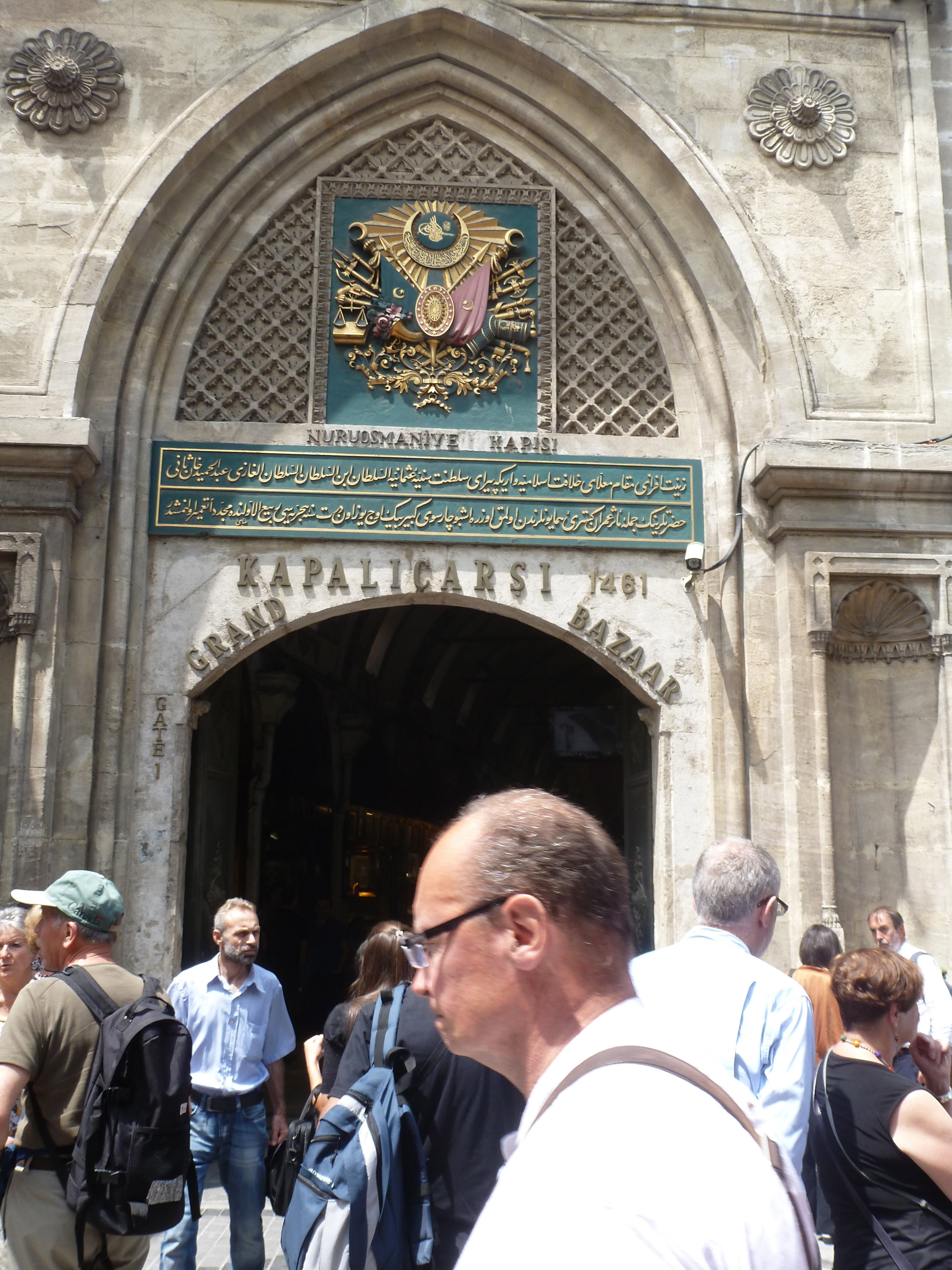
Entrance to Grand Bazaar

Entrance to Grand Bazaar

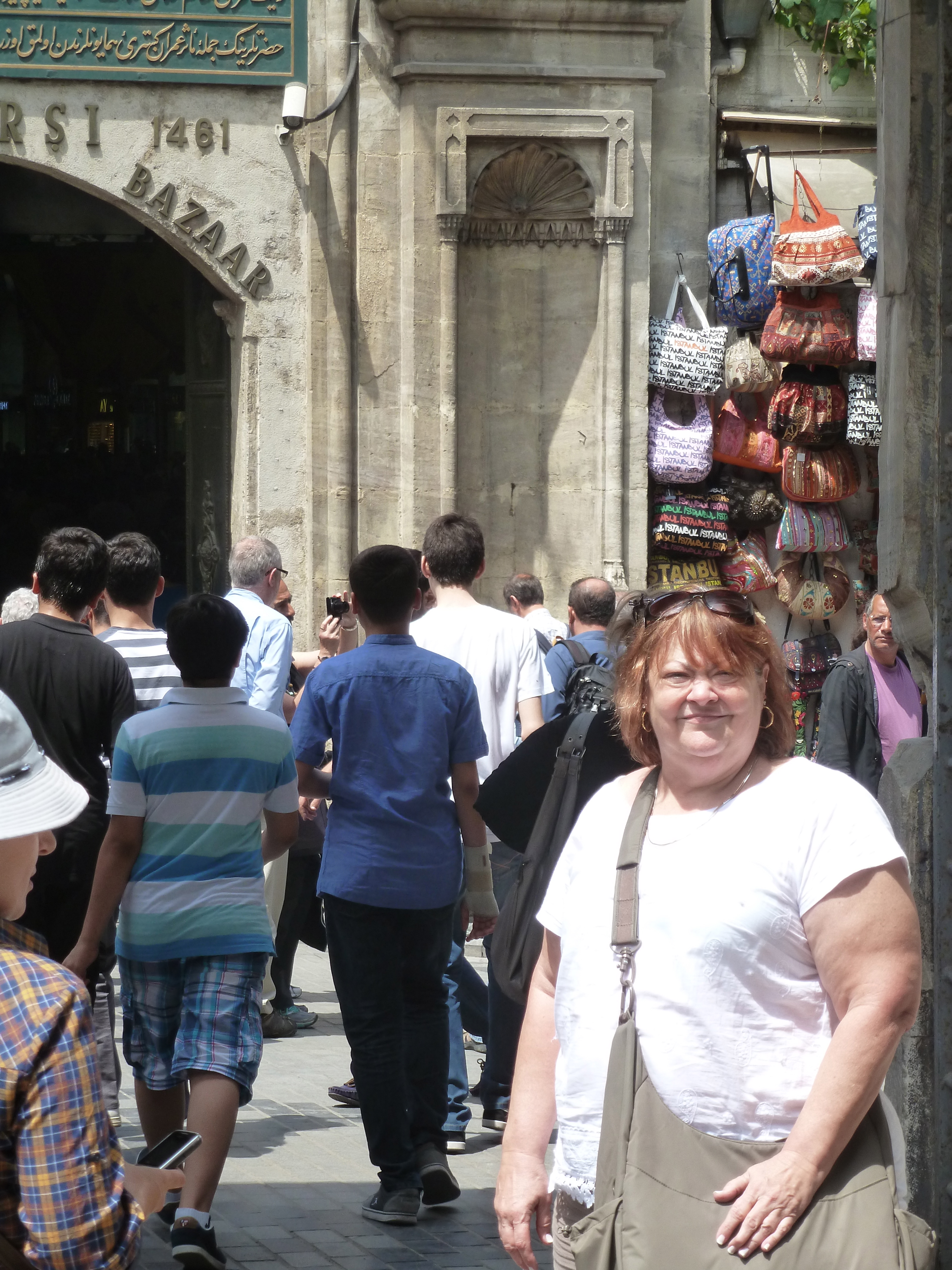
Cheryl at the Grand Bazaar

Cheryl at the Grand Bazaar

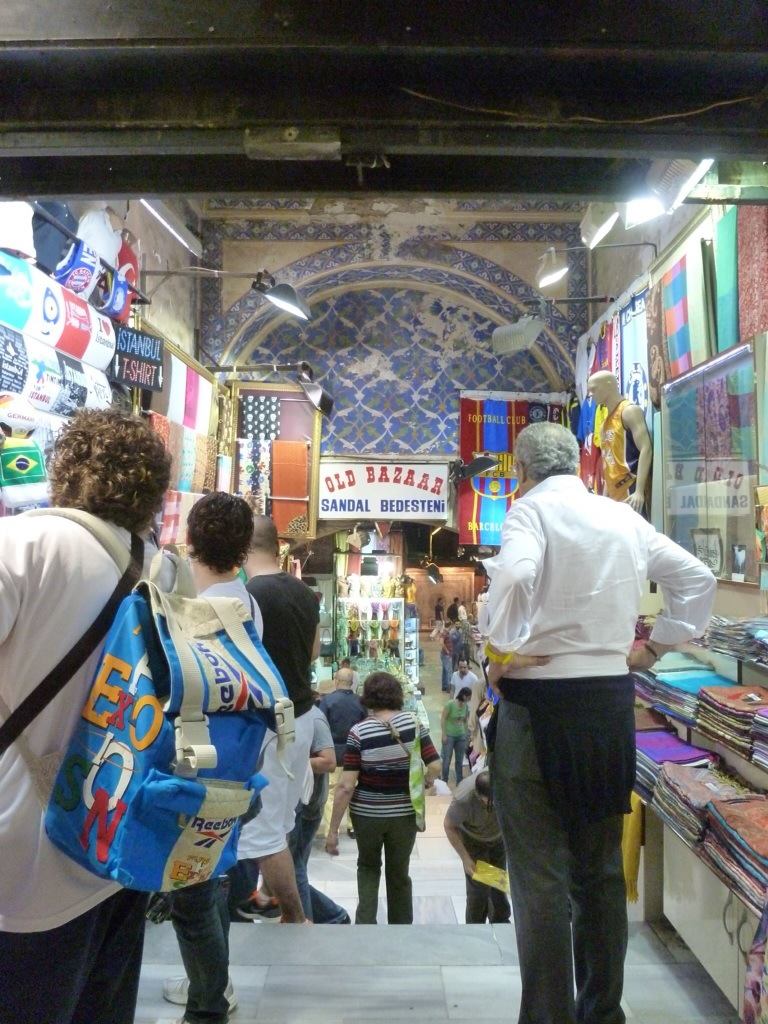
In the Grand Bazzar

In the Grand Bazzar

In June this year, though, I had even less time.  I was on a day-tour, and when we stopped at the Grand Bazaar area, we were hustled into a “shopping mall” first — and spent far too much time in the main carpet area being instructed on carpets.  It was interesting, but we were also being targeted as potential buyers.  I’ve been in carpet stores before and while this one was interesting, it meant that by the time I walked three or four blocks to the Grand Bazaar itself, all I really had time for was a quick entry into the main gate, a glance around, and a quick exit.  Clearly, I need much more time.

How much time, you might wonder?  Well, consider the facts about this bazaar.  It’s not known as The Grand Bazaar without reason.  Construction began in 1455.  It is one of the largest — and oldest– covered markets in the world.  In its 60 or 61 covered streets lie over 3000 shops (some sources peg the number at 5000).  Once this was also home to master craftsmen who demonstrated their various trades — metalworking, jewelry-making, weaving, and the like.  That’s no longer really there, sadly.  And many of the shops are filled with tourist tacky items, often made in China. There are some good recommendations from various guidebooks, but with a limited amount of time, you really don’t have time to spend searching these out.  Only tonight I found that The Grand Bazaar has its own website:  grand bazaar.org/Grand_Bazaar_Istanbul.html

So my true adventure in this most famous of Istanbul’s bazaars lies in the future.  Possibly next trip to Athens, I hope;  I’m tentatively planning on flying there through Istanbul, with a stopover.

The Spice Bazaar/Egyptian Spice Bazaar

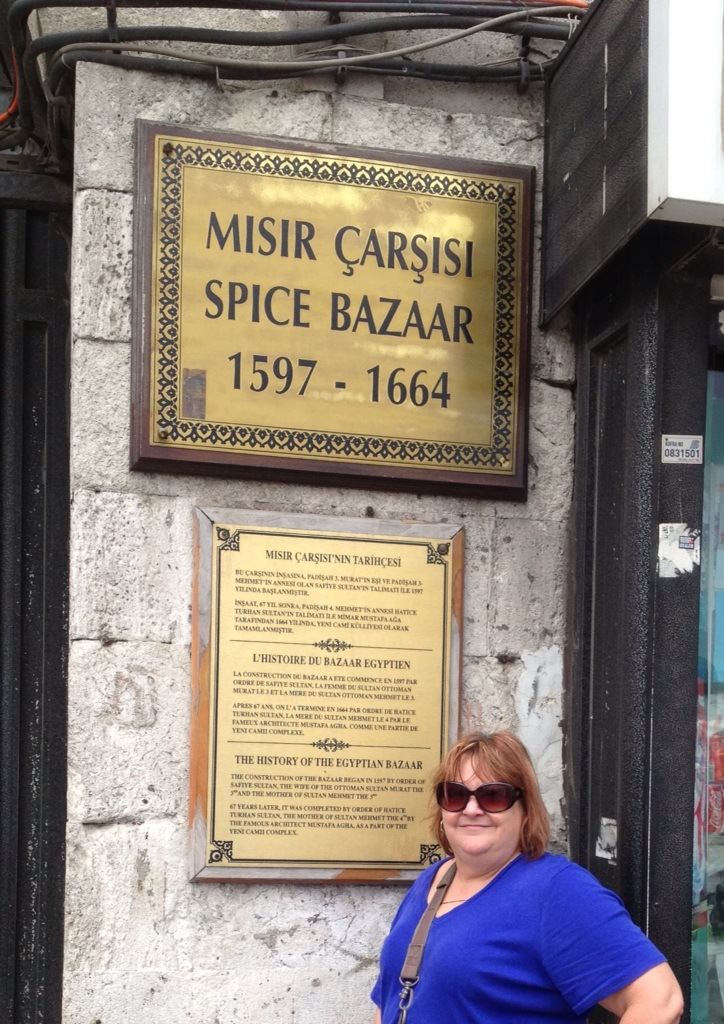
The Spice Bazaar

The Spice Bazaar

The second largest covered bazaar (after The Grand Bazaar), the Spice Market is in Fatih in the Eimonu neighborhood.  It’s a 17th century structure, with 88 vaulted rooms (with upper and lower storeys).  Unlike The Grand Bazaar, it’s open 7 days a week.

Perfume Oils

Perfume Oils

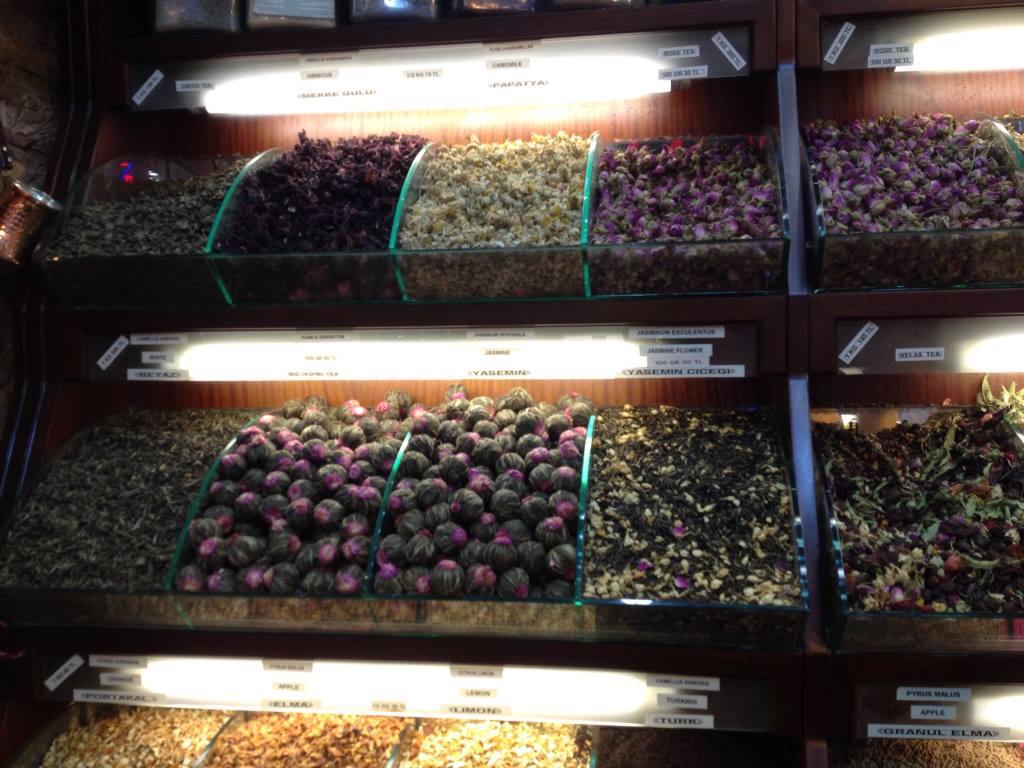
Teas to Choose

Teas to Choose

Spices of Many Colors

Spices of Many Colors

The Spice Bazaar was on my must-see list, and I did get to spend 45 minutes there — far too short a time, once more.  But that was because I found one lovely shop (Aladdin’s) near the main entrance and blew much money there, buying perfume oils, spices (particularly saffron), and teas (oh my, the variety).  Happily, I paid my small fortune, left the store, wandered a bit, and then exited to sit on the step right outside the bazaar.  Be aware that buying saffron can be tricky.  Be sure you’re getting the real thing.  Any number of travel websites about spice shopping here warn that often, if the price seems really too good to be true for saffron, it’s probably not really saffron, but another spice such as turmeric. Spend some time searching online for advice and warnings about shopping for saffron in Istanbul.

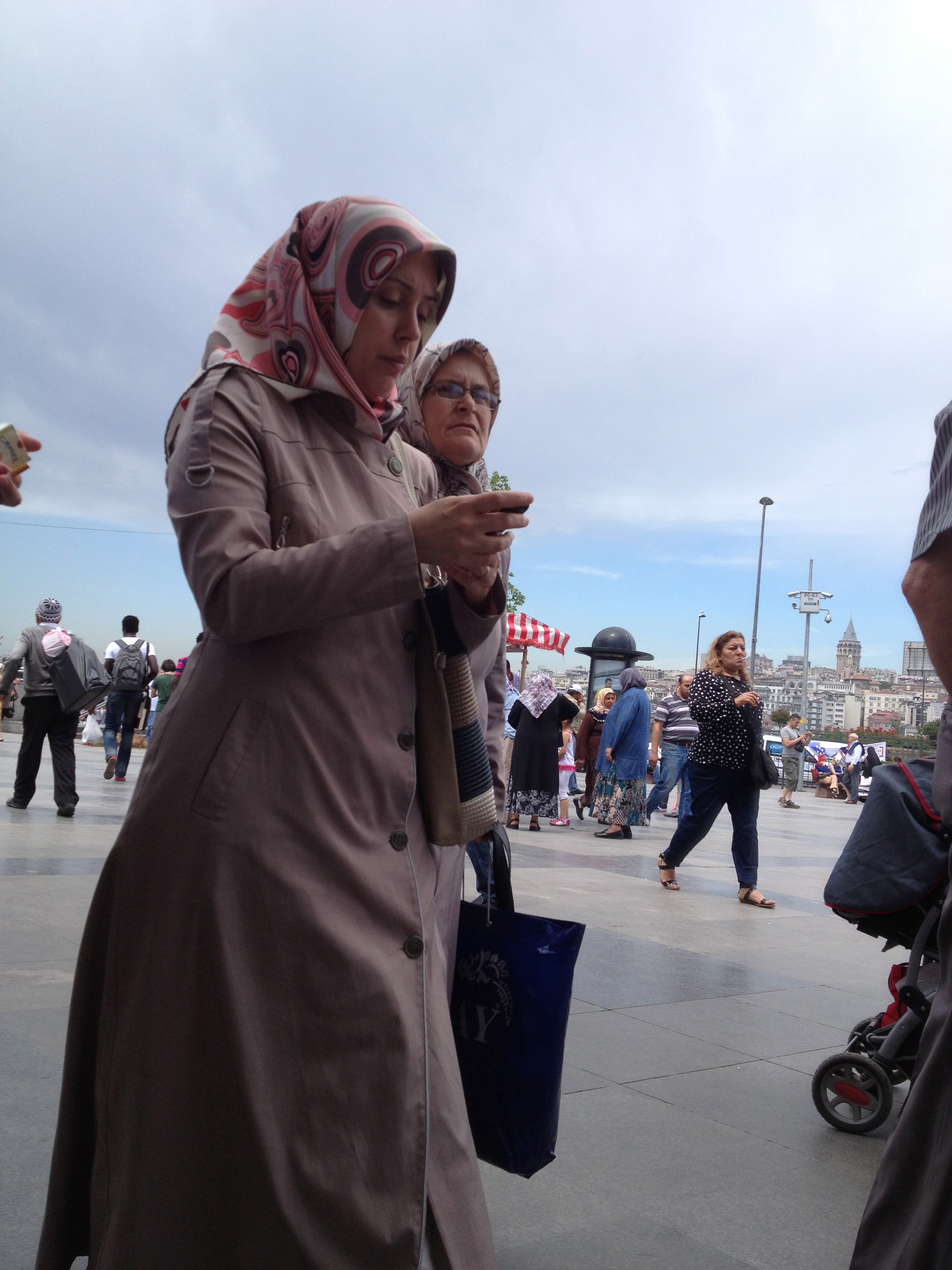
Near the main entrance is the Yeni Mosque is a great place for observing everyday life.  Besides the tourists shopping there, you’ll see locals as well, wandering with traditional clothing as well as modern adaptations.  The Spice Bazaar is on a large street and across from the entrance is the Bosphorus.  You can get a bite to eat from any of a number of street vendors, sit, and spend lots of time people-watching.

IMG_1063

And Modern Dress

And Modern Dress

The Blend of Traditional Dress and Modern Technology

The Blend of Traditional Dress and Modern Technology

IMG_1058

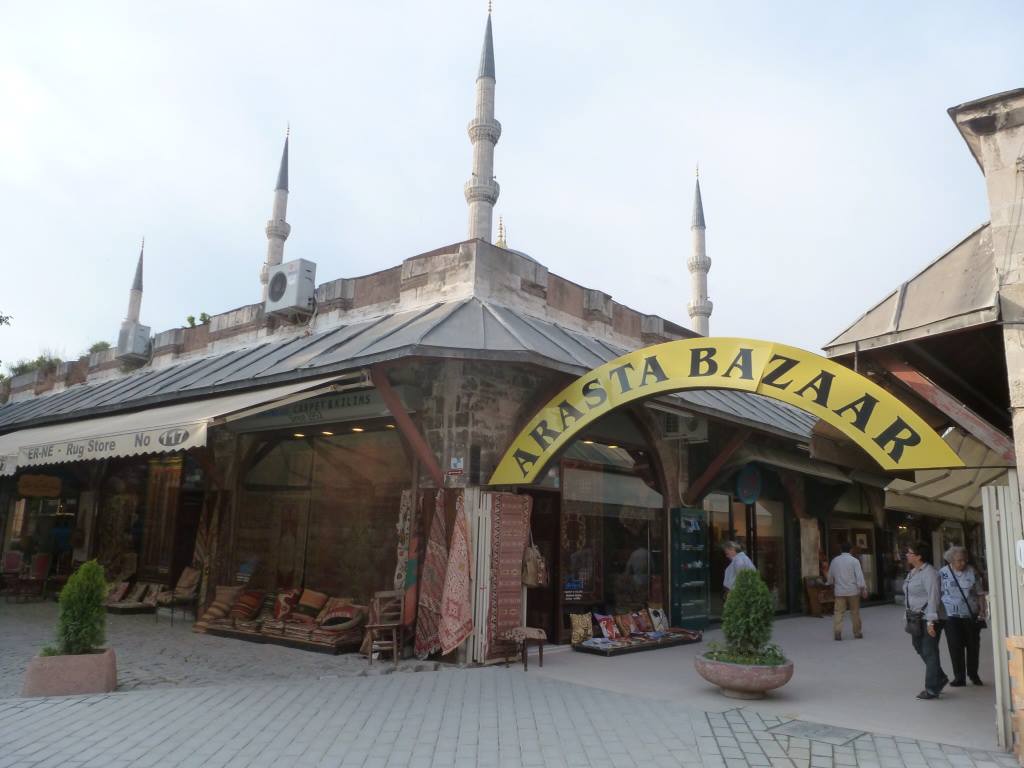
Arasta Bazaar — near the Blue Mosque

Entering the Arasta Bazzar

The third bazaar is much smaller and easier to navigate.  Situated two blocks behind the Blue Mosque (also known as the Sultan Ahmed Mosque or the Sultanahmet Mosque, built between 1609-1616), this bazaar also has its own website:

www.arastabazaar.com

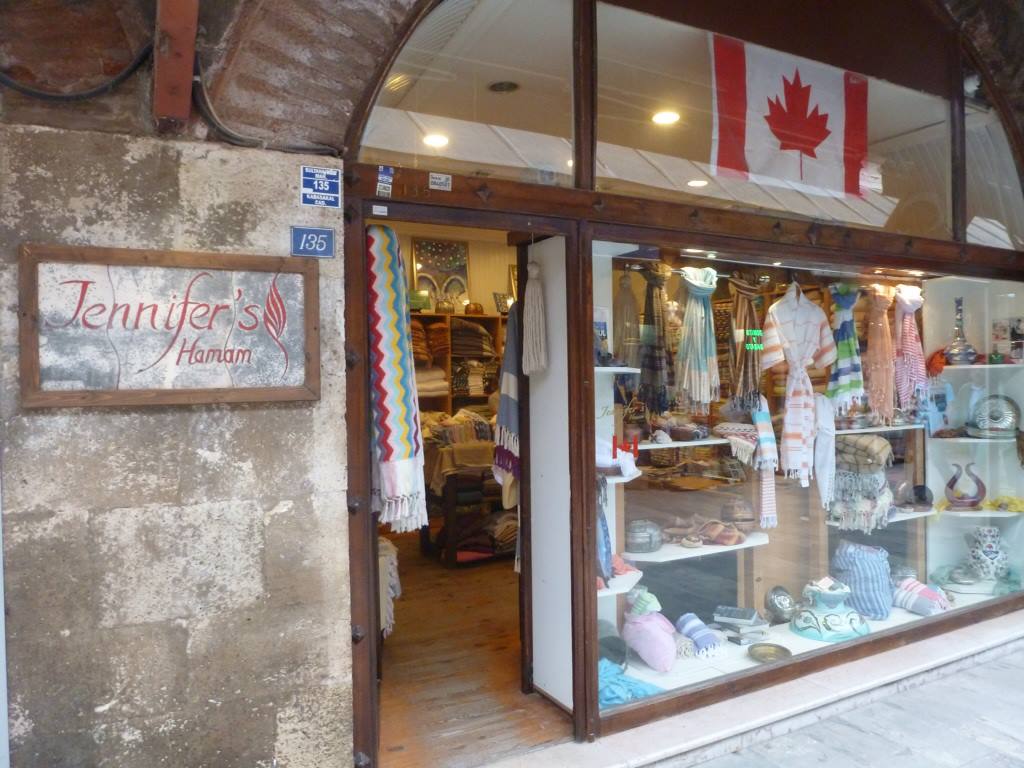
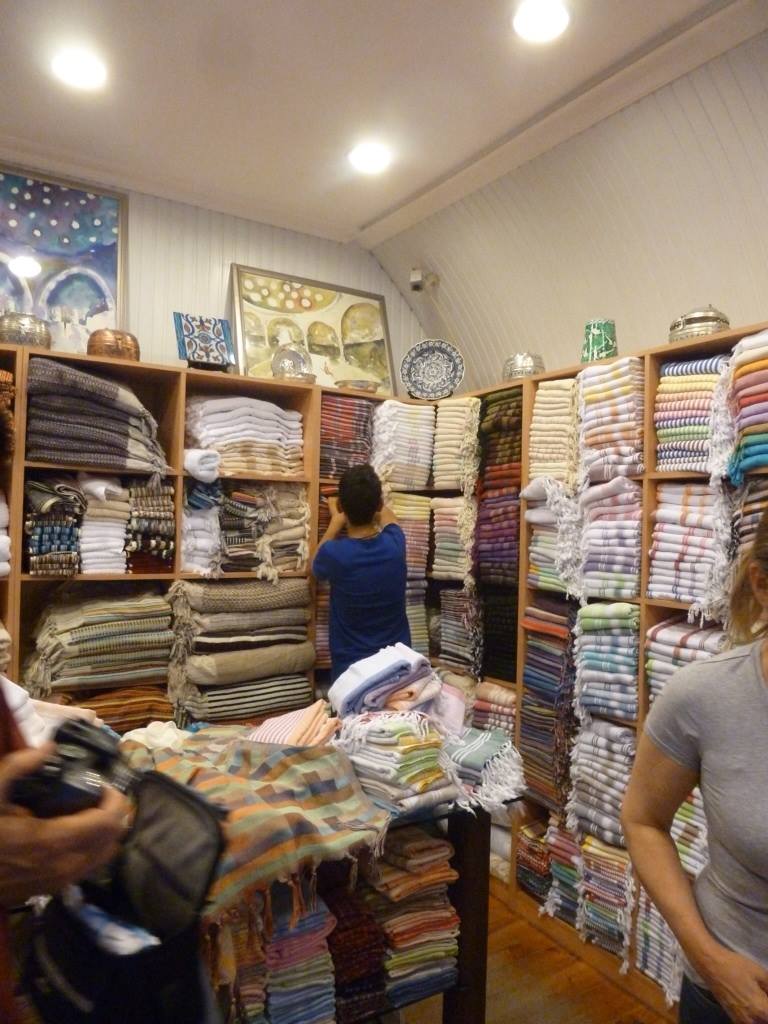
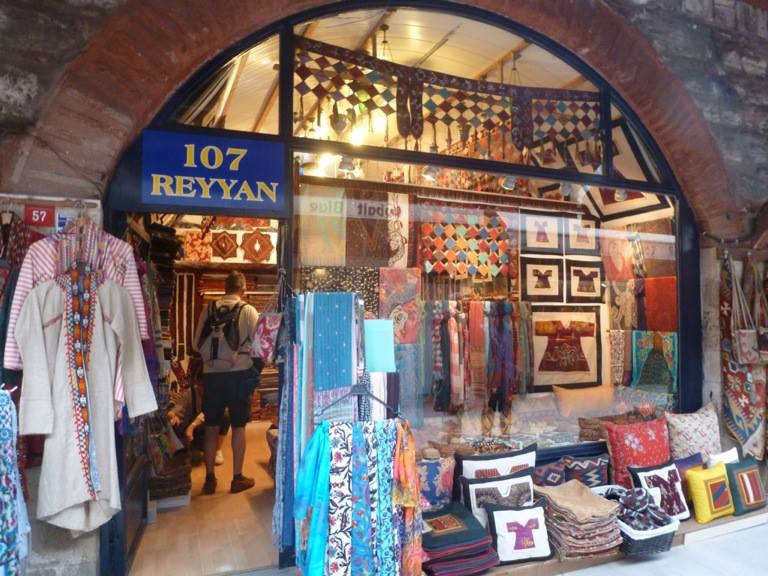
It even has a map with the shops named.  Having spent time online and with guidebooks, I knew there were a couple of particular shops I wanted to spend time in.  Another couple were lagniappe (Cajun for “extra), serendipitous finds that I am glad I wandered in.  One interest of mine is traditional Turkish weaving and fabrics, especially the pestamels, the kind of towels you get in many Turkish hammams (or baths).  Jennifer’s Hamam was one of my targeted stops, and well worth the time.  The store is one of two (there’s one in The Grand Bazaar) owned by a Canadian who sources her work from traditional weavers.  I bought several pestamels,  a beautiful blue silk scarf, and some other cotton items.  Jennifer was there and happily spent a lot of time with me, showing me different types of towels, different sizes and qualities of pestamels and matching hand towels, huge towels, bedspreads, and even bathrobes.  She also told me how she has built her business, finding traditional weavers and helping to re-build the dwindling numbers of trained weavers.  Her dream, she told me, is to create a handicraft collective, complete with a school so that the various associated crafts will not die out.  Jennifer does have a website, if you’re interested:  http://www.jennifershamam.com

Jennifer's Hamam

Jennifer’s Hamam

Inside Jennifer's Hamam

Inside Jennifer’s Hamam

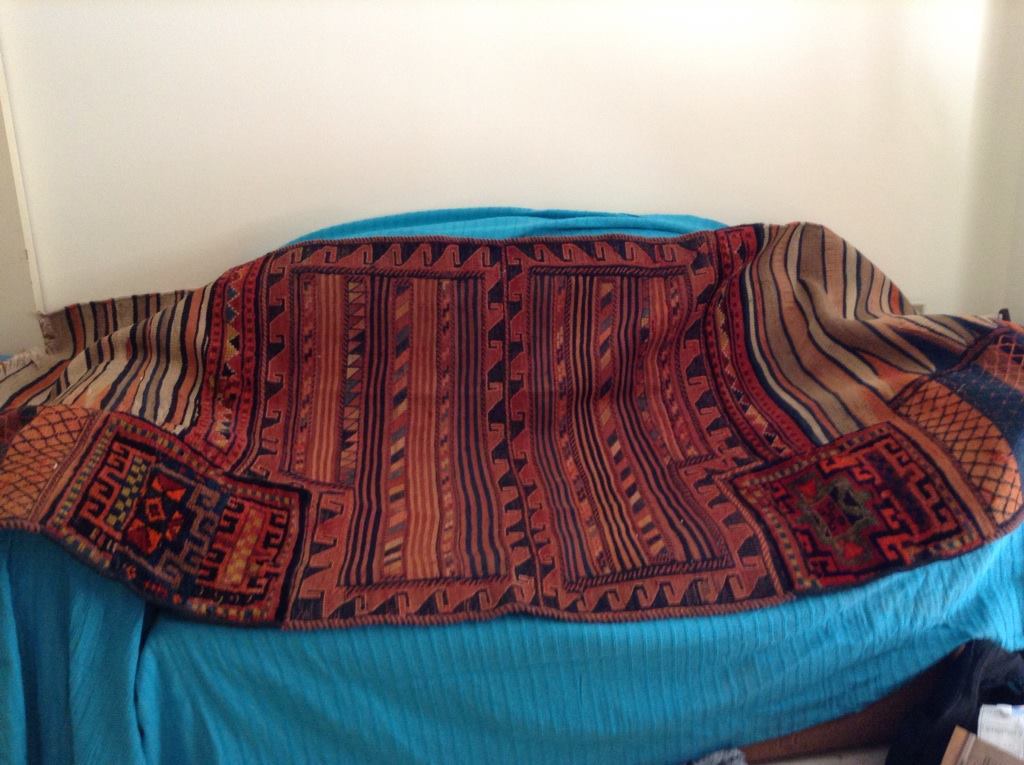
When I mentioned that I was also interested in buying a rug, she led my friend Seth and me through the bazaar, out of it, and to a nearby street to a very nice store (the 5K store), where I bought an old camel bag/camel rug.  Folded up, it functioned as a kind of saddle bag, specifically for using on a camel.  Though it looks like a patchwork of different rugs, it is actually a single rug, woven on a single loom, switching techniques.  For now, it’s living on the sleeper couch in my apartment in Athens.

A Camel Bag as Rug

A Camel Bag as Rug

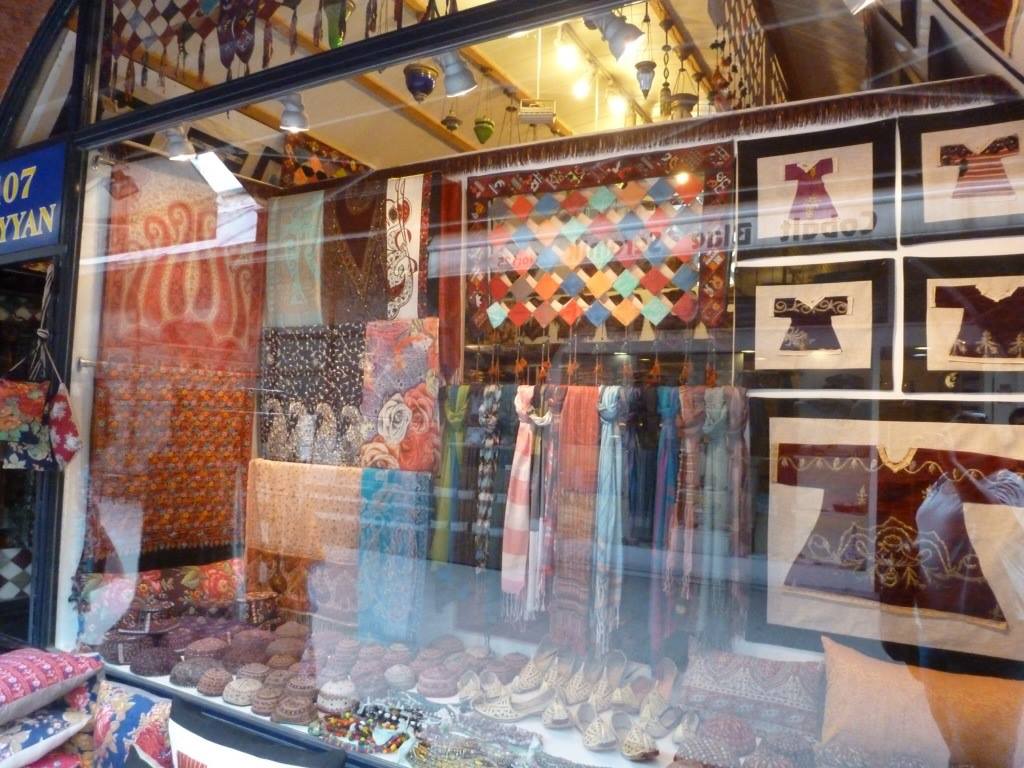
Besides Jennifer’s Hamam, I also shopped for scarves and hand-woven fabric.  I ended up with a beautiful shawl, several scarves, and an early 20th century textile that can be a wall hanging or a bracelet.

More Scarves in the Arasta BazaarScarves and More in Araasta Bazaar

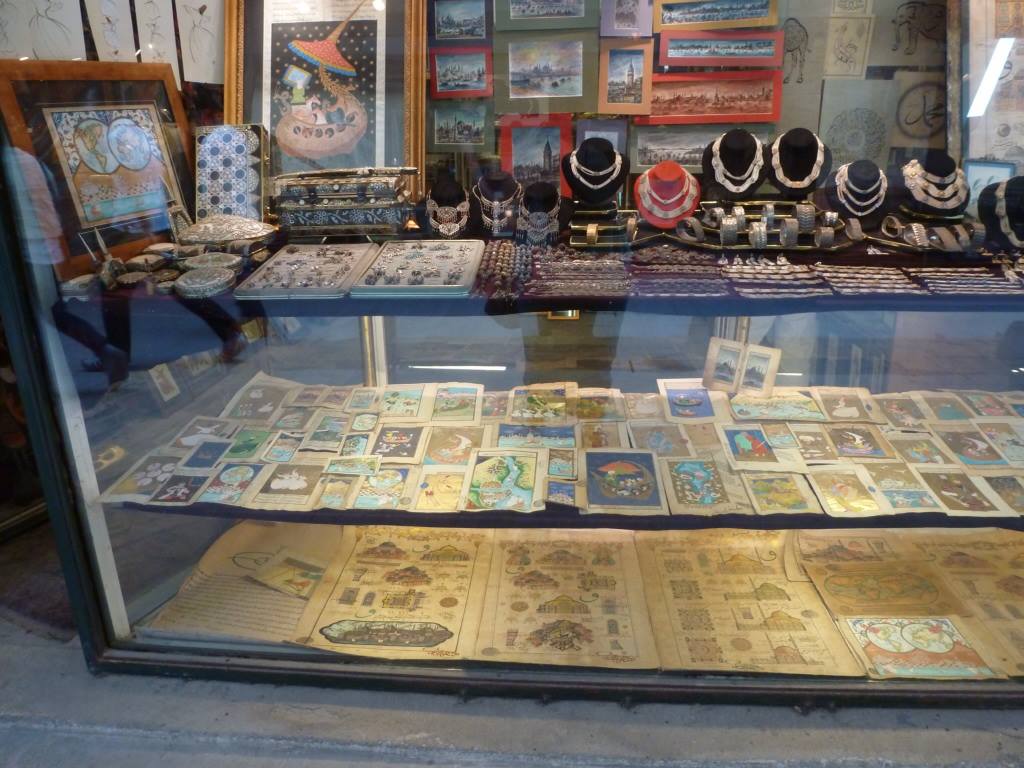
The store that surprised me, though, was one that sold illuminated manuscripts.  How could you not be drawn in by the window display?

For Illustrated Manuscripts -- Arasta Bazaar

This bazaar was also walking distance from the small hotel where I stayed, in Sultanamet district, perhaps two or three blocks away.  Since it was so close, I actually visited here a couple of times.  It’s also on my “must-return” list.

Though I didn’t go beyond these bazaars, there are apparently daily markets that are worth exploring.  I have already bookmarked a website about these (and the three bazaars I’ve talked about):

http://www.theguardian.com/travel/2011/sep/06/istanbul

Yes, Istanbul is a fascinating city.  I will go back, and back yet more times.  Other posts will explore different places and experiences, but since Istanbul (formerly Constantinople, or as my Greek friends still refer to it, Constantinoupoli) has been a port city where many trade routes crossed, it has long been known for its handicrafts and shopping.

I’d still like to find actual fabrics, traditionally woven cottons and silks that can be bought by the meter.  And I didn’t even look at jewelry this time.  Lord, watch out when that happens!

Categories: Uncategorized | Tags: , , , , , , , , | 1 Comment

“Simplify, Simplify”?

“Our life is frittered away by detail. . . . Simplify, simplify.”  So Henry David Thoreau pronounces in chapter two of Walden.  I am trying, truly I am, to follow his advice. But lord, it’s hard.

Maybe Thoreau could live in a tiny one-room house for a short period of time.  Maybe he could live with only a rudimentary wardrobe.  I can’t seem to manage either.

Since retirement, and specifically since Dad died, I’ve been trying to simplify my life.  In trying to sort through and purge the accumulations of decades (some moved from state to state, house to apartment to house), I am perplexed.  Just how did I manage to acquire all this stuff?

Kitchen:  Once a year, I pull out all the pots and pans and plastic containers in the kitchen cabinets.  I throw out anything worn out or useless.  I give away what I don’t need.  I usually discover duplicates of some things.  This is an on-going process.

Clothes?  I’ve actually done an okay job, at least in terms of a yearly attack of purging and giving away/donating and throwing out.  Yet I have to do more — I will simply never wear dozens of t-shirts, no matter how gripping or amusing the quotation/text/motto printed.  And why do I have so many tops?  So many pairs of shoes?  (Okay, I get the shoes.  I’m a shoe-aholic.  Yet I am controlled in purchasing new shoes.  Sort of. Not Imelda Marcos-level in shoe purchases.)

Especially since retiring, I’ve been periodically returning to purge more and more clothes.  At least I have thrown out what’s worn out.

Then consider the books.  There, too, is kind of an excuse:  I taught literature and writing at university.  I read.  I read a lot.  I have hundreds of books, lining shelves of various bookcases.  There are bookcases in almost every room of my house.  There are books in boxes on the floor of my back room — books I mean to donate or give away.  I’ve done a fair job over the last few years of reducing my square footage of books.  Now I’m ready to tackle that problem again after not having time to do so. I’ve sorted and thus the boxes — but now I must figure out what to do with the books that are going away.  This summer I resolved to sort through the academic books spanning British literature and American literature and reduce what I keep.  I know I won’t teach again, and so rationally know that others might well use the books.  But again, I find it difficult to actually follow through with the rational recognition that it’s simply time to let them go.  Or at least to let a lot of them go.

I’ve decided to be ruthless — I don’t need the Norton editions of so many books.  Only some.  I don’t need the British literature texts.  Just Shakespeare.  And A.S. Byatt.  And a few more.  But my shelves of Faulkner and Southern literature and criticism?  Those have to stay for a while.

Autographed texts?  Those stay.

Contemporary poetry?  Stays.

Books on Greece and Greek language?  No question at all — those stay.

And the travel books are here for keeps too — at least the books about travel.  The out-of-date guides, though, will be purged.

Since I am an avid reader of “junk” fiction, I have accumulated dozens of paperbacks — mysteries, science fiction, fantasy.  I’ve gotten rid of a lot.  Yet there are still so many I can’t quite let go of.  At least now I buy in e-book form.

Only this afternoon I’ve been working on re-organizing the books I want in my office, close to where I’ll need them.  The craft books.  The books on publishing.  The books on poetry forms.  The books on non-fiction.  Decorating books?  Those will go elsewhere in the house.

Magazines?  I’ve thrown out bags and bags of these, yet where did the stacks on the bookshelves in the living room appear from?  Those I plan to tackle one day next week, ready to dump most of them.

And just where did all of these duplicates of things appear?  How/why did I end up with five staplers of various sizes and shapes?  With multiple tape dispensers?  And pens?  With various colors of ink?  I will keep one large and one small stapler for here, keep one of each for the beach house, and put the rest in the garage-sale pile of “stuff.”

Part of the problem, I’m sure, is that some items are boxed and only now am I sorting through boxes, discovering that I’ve bought multiples simply because I didn’t realize what I had.  There are items from my work office at the university.

And then there are the boxes of “I’ll deal with this later.”  It’s later.  It’s time.

I’ll never be able to reduce my footprint so much that I could live like Thoreau in his cabin at Walden Pond.  But I fantasize about at least eliminating and purging what I simply don’t use or need.

Record-keeping and sorting through files?  Imposing order and labeling — that’s what I’m doing now.  I’ve dumped lots of teaching files, but not all.  Research files?  Those are staying.

My nightmare?  That I’ll end up a star on television — on Hoarders.

Don’t even think about the 10×15 storage unit that has what Kay and I have moved from Dad’s house (and in which some of my overflow acquisitions are stored).  Most of my own stored stuff has been purged and sorted already — once or twice.  I will attack it again, too.

Daily I think about two issues — accumulating and cluttering.  I make headway weekly.

Clutter?   I keep plugging away at organizing and controlling it as well.  Much improved in this endeavor, but not yet conquered.  Of course, you understand I’ve bought books on controlling clutter, which only contributes both to the book problem and the clutter problem.

Clutter. Chaos.  Cheryl.  Do you see the destiny revealed in those three C words?

Categories: Uncategorized | Tags: , , , , , , , , | Leave a comment

Allons Danser

Dancing is one of the most joyful things I know.  I don’t remember not knowing how to dance.  In fact, when I was a toddler, my grandmother Ella taught me how to dance by having me stand on her feet so that I simply got danced — and eventually I knew the steps by myself.

She grew up in South Louisiana in Cajun country.  Though she often denied any Cajun heritage (only claiming the Irish), our family genealogy clearly indicates her own grandmother was a LeJeune.  Sorry, Ella — that’s Cajun.  

Besides, the music and food she shared with me — and with all of us grandchildren?  Cajun.

She loved to dance.  She’d dance around the house while she cleaned, or dance in the kitchen as she cooked.  Sometimes she’d simply break into dance and sing along.  It was as natural to her as breathing.  Music was just part of her.

And so it is with me, in part because of her.  Recently, my cousin Carolyn and I were talking about this.  She too learned to dance — though she says our grandmother placed her on the vacuum cleaner and danced her around with that.  Carolyn and I share similar memories, but we also share the result:  we both dance around our houses while we sing or clean house.  

For me, that music was Cajun music, requiring a two-step dance or a waltz.  Even now I feel my feet moving on their own if I hear particularly evocative music.  Last night, for example, while I was watching the Louisiana Public Broadcasting channel, I caught a program about the song “You Are My Sunshine.”  The state song, it is credited to the late Governor Jimmy Davis, who used it as his campaign song.  The entire program was this one song — as sung by a wide variety of Louisiana artists.  Every style from gospel to blues to jazz to Cajun and zydeco, from singers like Marcia Ball, Allen Toussaint, Buckwheat Zydeco, the Rebirth Jazz Band, Buddy Guy, Zachary Richard, and the Marsalis family band — all narrated by Harry Connick, Jr., who also performed the song.  

And I found myself getting up and two-stepping around the room.  Couldn’t resist it.  The music just pulled me up, set my feet to steps so familiar.  The dogs and cats weren’t quite sure what was going on.  They never quite know what to do when I start dancing.

Cajun music is part of our heritage from the French-speaking Acadians who left Nova Scotia — and there are also obviously ties to older French music.  Dancing to Cajun music might be with a quick two-step or a smooth, lilting waltz.  Closely related is zydeco music, the music of black Creoles.  Cajun music involves fiddles, accordions, triangles, as well as drums and guitars (linked to country music).  Zydeco music shares the same instruments, plus the washboard.  

When I was growing up, we called Cajun music “chanky-chank” music.  But in the late 1950s, 60s, and 70s, younger musicians began to play and record traditional Cajun music, writing original music in the style, and revealing the influences of not only country-western music but also rock and roll.  So we had “swamp pop” (usually in English) with lots of local bands.  And a group from the Lafayette area, Beausoleil, became one of the best-known and most popular of the younger musicians keeping the old music alive — and making it new again.  I saw them only a couple of years ago, and it’s impossible to stay still when they’re playing.

Thanks to YouTube, it’s easy to link you to some videos of Beausoleil performing live.  the following link also includes dancing, so if you’re not sure what Cajun music sounds like and what Cajun dance looks like, follow this link: 

And if you go to any number of local restaurants in Acadiana (the parishes in South Louisiana that are the Cajun prairie area), there will be  Cajun bands playing on Friday and Saturday nights, and there will be a big dance floor — filled with couples, but also with parents or grandparents and children.  It’s very much a family affair.  

The love of music and dance is deeply embedded in the Cajun culture of Louisiana (especially South Louisiana).  Add the love of good food.  Add some beer.  And you have a festival.  There are more festivals than I can count — there’s even at least one calendar  simply for festivals in the state.  You name the product or animal/seafood or music, and you’ll find a festival.  In Acadia Parish, where I grew up, the festival is The International Rice Festival, in October.  Here in Lake Charles, we have Contraband Days in May (celebrating Jean Lafitte).  In Rayne, you’ll find the Frog Festival.  Go a little more east and you’ll find the Crawfish Festival.  In Cameron Parish, south of Calcasieu Parish where I live, you’ll find the Fur and Wildlife Festival.  There’s a Swine Festival.  a Shrimp Festival, an Arts and Crabs Festival, an International Zydeco Festival, several Cajun music festivals.  Lafayette is home to Festival International, celebrating the Francophone countries and their music and foods.  I think you get the picture. 

I love to dance — and to watch really good dancers.  Some older couples who’ve danced together for decades make the Cajun waltz or two-step an art form, a thing of amazing beauty.  

A child of the 60s, I also loved to dance to rock and roll.  Still do, though not at clubs anymore.  Just around the house.

My grandmother was still going out to dance well into her late 60s and early 70s.  She had a brother who actually had a heart attack and died on the dance floor — when he was dancing with his second wife.  

Today I was driving around, listening to a new CD by Hugh Laurie — pure New Orleans Dixieland music.  And I’m sure anyone watching me would see me and think I was having some problem.  Yes, I move to music even while driving.   My head and shoulders move in time to the music, though I’m seated.  It’s the car version of seat-dancing, which I do at concerts even if I can’t get up and stand while moving.

When I was in high school, I’d go to Saturday night dances at the Knights of Columbus hall in Iota — and for what we called “fast dances,” girls danced together most of the time because guys wouldn’t.  Slow dances?  That’s when they most often got out on the dance floor with us.  But at school dances they were more likely to dance to all the tunes.

In college, I’d go dancing whenever I could.  it wasn’t unusual to head to the Keg on Wednesday nights.  And Friday nights.  Maybe Saturday nights too.  Another local hangout was the Lighthouse, complete with black light and a mirror ball.  

When I moved to Texas to teach at Lamar University, in 1975, it was possible to find disco music, but it was also possible to find a place like Momma’s Worry, where you could dance to all kinds of music, including progressive country.  Once when a group of us were out there dancing, Sam Gwynn and I were jitterbugging and our hands slipped apart — and I went sailing through some doors.  No damage, luckily.

Of course, we danced in parks when we went to some festival or to hear a band.  We danced at our own parties.  When I lived in College Station, after I went to grad school for my Ph.D., we’ d spent some weekend nights at Grins, a bar owned by parents of one of my fellow students — and dance.  We’d also occasionally end up at the Hall of Fame (aka the Hall of Shame), where we’d dance to country-western music.  This was the height of the Cotton-eyed Joe craze, complete with the dance floor  jam-packed with us line-dancing and yelling “Bullshit” while we kicked and laughed.  The dance, by the way, was an adaptation of a German schottische.  

Only in Texas can you find a blending of German and Mexican music — with Mexican polkas.   And you can also find the Cajun influence as well, since Cajuns moved westward along with oil-field work, bringing their music and food.

So in Texas I can find gumbo and kolaches, enchiladas and barbecue.  

Even my dad danced, though he grew up in a church that did not approve of dancing.  He and Mother would occasionally dance at friends’ houses and small parties, and also around the house.  They also sang, separately and together.  We sang together.

Music was part of my DNA.  Singing was just what we did.  And I was destined to dance.  

So if you pass me in a car tomorrow, don’t be surprised by the crazy lady seat-dancing in the driver’s seat.  Just turn your own music up and appreciate it.


Categories: Uncategorized | Tags: , , , , , , , | 2 Comments

What’s Your Bumper Sticker?

Does your car have bumper stickers?  What should I think about them? About you?

It’s interesting to read bumper stickers on cars — whether I want to or not, when I’m in traffic, I find it difficult to ignore them.  Especially if the cars are near me.  Some of those bumper stickers are familiar; others are not.  Some border on the obscene.  Many are political, often for beliefs or attitudes I don’t share.

I get annoyed at the ones that have some little guy peeing.  In fact, I’d just like to peel those off.  But most of the time, I like to connect the bumper stickers to the people driving the car (or truck) and imagine what they’re like, or why they’d put that on their vehicle.

I’m one of those people who collects bumper stickers.  Some of them are even on my car.  And I remember bumper stickers I no longer have because they’re on cars long gone.

One of the first I ever put on was on the 1962 Chevy BelAir station wagon I drove in college: I went to McNeese State University and our arch rival in football was the University of Southwestern Louisiana, aka USL (it’s now the University of Louisiana at Lafayette).  For some reason, “Go to Hell USL” didn’t stay on my bumper long.  Clearly some USL fan ripped it off, at least in part.  The second was on a Chevy Monza that I bought in 1979 when I was in grad school at Texas A&M University; “I Brake For Armadillos” just made perfect sense to me.  Over the years, various other bumper stickers ended up in my office — “Mamas, Don’t Let Your Babies Grow Up To Be Davidians,” “Well-Behaved Women Seldom Make History,” “Native-Born Texan.”

Something about retirement, though, triggered some urge to plaster more on my car. Short of finding a used VW van and painting it psychedelic colors, I simply began to select new bumper stickers.

If you pass my 2012 Prius on the road, you’ll notice the “I Love My Shih Tzu” magnet on the side.  If you’re behind me in traffic, you’ll have more to focus on.  First are the two oval stickers for cars:  GB (Great Britain) and GR (Greece), two of my favorite countries.  Maybe I should simply start collecting them as I travel and use the car as a vehicle (lol) for a visual travelogue.

Last week, I put on two rectangular stickers on the back bumper, one on the right-hand side, one on the left.  On the right is a colorful “Coexist,” complete with a peace symbol as well as symbols from various religions.  Obviously, this is my comment on religious intolerance — of any and all flavors.  On the left-hand side of the bumper is a quote from an Emily Dickinson poem:  “Dwell in Possibility.”

That’s the one that I linger on, frankly, when I walk around my car in the driveway (or anywhere).  Dickinson is one of my favorite poets.  Enigmatic, Dickinson’s poems “Tell the truth but tell it slant,” and I love reading her poems.  They make me stop and puzzle, tease out possible meanings.  And “Dwell in Possibility” resonates for me.

Here’s the entire poem —

“I dwell in Possibility –
A fairer House than Prose –
More numerous of Windows –
Superior – for Doors –
Of Chambers as the Cedars –
Impregnable of eye –
And for an everlasting Roof
The Gambrels of the Sky –
Of Visitors – the fairest –
For Occupation – This –
The spreading wide my narrow Hands
To gather Paradise –”
Characteristic of her work is that use of the dash as punctuation of choice, rather than a period.  Think about it, though.  A period announces the end.  A dash simply continues.  And where do those dashes appear?  In a line — connecting a thought — or ending a poem —  and the placement of the dash makes a comment.  In the middle of a line or connecting two ideas, the dash links, mirroring a thought process.  At the end of a line or the end of a poem, the dash suggests continuation, not ending.  And in some contexts, that choice means something significant.  In this poem, for example, the last line is “To gather Paradise –” as though the gathering of Paradise (whatever that might be, whatever follows, continues.  The ending opens up rather than concluding.
And what about “I dwell in Possibility”?  I tend to read this as a poem about either poetry itself (“a fairer House than Prose”) or about religious beliefs, specifically about an afterlife.
However you read it, this poem accepts and perhaps even celebrates the lack of a given — for that is what possibility denotes.  And announcing right off the bat that she dwells “in Possibility” suggests something positive, something wide and embracing and limitless, not something fearful or limited.
Consider situation one, that possibility is about poetry itself.  With this reading, poetry offers a wider “house” than prose (and I might enjoy discussing that with her) with more windows and superior doors (for access both into and out of, I assume).  “Chambers as of the Cedars” (strong, perhaps, and also suggesting some spiritual meaning, perhaps of an afterlife) — the chambers of poetry, then, would offer some continuation, some kind of immortality.  “Impregnable of eye” — poetry isn’t something that is always something the eye/reader/poet can penetrate; sometimes the “meaning” is something even the poet may not fully intend or grasp.  Poetry would have an “Everlasting Roof / The Gambrels of the Sky–“; again, a suggestion that poetry lasts; also, that the “house” of poetry is part of the world itself, so that the roof simply is part of the sky/the heavens/the world.  Readers (“visitors”?) are the fairest for occupying this house, and for them the poem, from the poet’s “narrow Hands” spreads wide, opening up “To gather Paradise –“.
Or consider this as one of the many poems reflecting Dickinson’s religious beliefs.  Some poems suggest that Dickinson wasn’t certain of what came after death, though she seems pretty certain that something does.  She had moments of doubt.  Despite this doubt, she would write “This world is not Conclusion.”  And the poem here, “I dwell in Possibility” obviously fits in.  What follows might not be certain — but something does — and she dwells in possibility, not worried about the uncertainty of what exactly the nature of that might be.  As in “Because I could not stop for Death,” where she writes of the grave as a house, and in terms that are not frightening but comforting, here too the house itself is described in terms that are positive and even comforting.  If the grave is a house, it is one whose roof is open to the heavens (and Paradise), and the occupants have access.
That bumper sticker says much for me, in three small words.  A life philosophy, it reflects my own choice to consider that while I might not know or be certain what is coming (in life or death), something is there.  Or some things.  Possibility.  Possibilities.  I choose to dwell in possibility.
Some bumper stickers, though, are just my own smart-ass comments.  Such would be reflected by a bumper sticker with a Davy Crockett quote: “You may all go to hell.  I will go to Texas.”
That’s going on the truck.
Categories: Uncategorized | Tags: , , , | Leave a comment

Baby Boomer Caregiving

My friend Charles and I are not alone. We were the primary caregivers for our respective parents. I had sibling help — my sister Kay was my much-valued tag-team caregiver. Charles, though, is an only child.

Charles is six months older than I; we’ve been friends since his sixth birthday in January 1957, when my family moved to the Sun Oil camp in Egan, Louisiana. We started school together; we graduated high school together. Our parents ended up buying land and moving houses, living across the street from each other. My mother died in July 1993; his dad died in December that year. He became a full-time caregiver for his mother in 2009 or so. I was part-time caregiver for my dad at that point, but became full-time by 2010.

My point? We were born in 1951. We’re baby boomers. Between 1946-1964 nearly 74 million of us were born. In 2011, the first baby boomers turned 65. We’re living longer. We’re redefining retirement.

We’re also increasingly part-time or full-time caregivers for our parents (or other relatives). According to the MetLife Study of Caregiving (https://www.metlife.com/mmi/research/caregiving-cost-working-caregivers.html#key%20findings), almost 10 million adult children over 50 are now caregivers for aging parents, and the number grows daily.

It’s an interesting study, one well worth spending time with. Lots of statistics there might surprise a reader. Certainly an eye-opener is the financial cost for caregivers: nearly thee trillion dollars in estimated lost wages, pension and Social Security benefits. That’s startling. I was more fortunate than many: I was close enough to live with Dad and commute to work for a number of months before I retired and moved in full-time. I had a flexible job (teaching at university). I had the support system available in the small town I grew up in. My sister lives 3 hours away and was (and is) still working. She was my tag-team partner.

We had no long-term care insurance, but Dad had Medicare and Social Security and no mortgage. Charles’s mother had long-term care insurance that had been beneficial but was eventually not renewable (she had purchased it when it was a new product, and terms have since changed). Her savings and Social Security and Medicare then filled in.

By the time Charles retired, he needed to live with his mother to help defray hired caregivers. As he puts it, he had “the night shift.”

I never got to the point of having to look for hired caregivers — Dad was still mobile, still driving, for quite a while. When he was no longer able to drive to dialysis, I had help from a friend. I was lucky — the caregivers I knew were actually already working, for Charles.

Having friends so close was wonderful. We were (and continue to be) each other’s support system, or at least part of it. We shared stories, suggestions, talked about Home Health care and hospice. We shared mowing equipment. We shared laughter.

In addition, I spent a lot of time on the internet while Dad was sleeping or in dialysis. I read for pleasure, certainly. I played word games like Scrabble or Words with Friends. However, I also searched out what I could find from other caregivers’ stories online.

Many baby boomer children don’t live as close in proximity to their aging parents, and thus have to arrange many things long-distance, relying on others, hired and otherwise. They must take time off from work and travel to their parents’ homes. And if, as is the case, many of them are also caring for their children, they are what are known as “the sandwich generation.” That would be where my sister fits in. I lived 45 minutes away from Dad. While he was working, Charles lived in Houston, several hours away from Egan. Between us, we fit a lot of different descriptions for baby-boomer caregivers.

I still look at websites about caregiving; I still read about it. While I am no longer a caregiver, I still have residual interests and issues that are directly related to it.

Once you’ve been a caregiver, I think, you’re changed, for better or worse. For both, if I’m honest. Certainly there are difficult times, physically, financially, and emotionally. If parents don’t have adequate secondary health insurance in addition to Medicare, their children often pick up financial responsibilities. Second mortgages on homes may result. Savings get tapped into. Searching for various agencies that provide assistance can be frustrating.

Becoming a caregiver is often gradual. Certainly that was my case. My dad was fiercely independent. Even in his 80s, on dialysis, he drove himself three times a week for the three-plus hours that kept him alive. He had stents. He had triple-bypass surgery. And three months after that triple-bypass surgery, he was in a ground deer-blind, with his gun, ready to hunt. He didn’t get anything, but that wasn’t the point. He was determined to keep as much of his life in control as possible.

He knew he was slowing down. His attitude was frankly amazing, though — good-hearted, with humor, and a no-bullshit approach to reality. He didn’t have to like it, and he’d express frustration. As he weakened, he was more vocal about being “useless” when he couldn’t help out with yardwork, or climbing a ladder, or doing something he was used to doing.

He was more forgetful — I began going to doctor’s appointments with him. I had power of attorney. I kept track of medicine. I managed more and more. By the time he was on oxygen and had to carry his tank with him everywhere, I was the driver. I’d drive us to the family farm in East Texas. As I’d drive, we’d talk and laugh if he didn’t nap. It was nice, he admitted, to be the passenger for a change — he got to enjoy the scenery. He’d grin and chuckle – – telling me he had a pretty good chauffeur.

I am only one of millions of baby boomer caregivers. Yet I wonder about what will happen when it’s my turn: I have no children. Some of my friends and I laugh about needing to set up our own commune (yes, you can tell we’re baby boomers!), complete with an on-site nurse. Yet it’s a serious concern, one worth planning for. I don’t have long-term care insurance. I’ve got a defined pension. I’ll have Medicare and my state insurance will become secondary. I’ll have a tiny bit of Social Security (because I worked for Louisiana, which doesn’t contribute to Social Security, I will have my minimum Social Security benefits that I qualify for docked at least 40%). I have a house with no mortgage, and other real estate that I could, if necessary, liquidate. I have an IRA. I’ve bought an annuity. Somehow, I hope, I’ll be able to piece together enough for my own care. And I would be willing to live in a retirement center, if necessary.

That’s long-term, I hope. Dad was not quite 90 when he died. His older sister is 92 now, and still lives alone. Their last aunt died in 2010, nearly 105 years old. She lived by herself until her 99th year.

I hope that I can approach my life (and my death) with the fortitude, honesty, and attitude that my dad did. With the patience and lack of complaint that my mother did. That would be honoring them and their examples.

And I hope I can continue to laugh, as they did, almost to the end. Oh, and dance around the house (even if it’s more like shuffling after awhile) while I clean house or cook — listening to music and singing — as my grandmother did.

Pretty amazing examples, when I think of it.

Time for some music, I think.

Categories: Uncategorized | Tags: , , , , , , , | 1 Comment

Blog at WordPress.com.