Monthly Archives: September 2013

Road Trips and Travels with Dad

When I was growing up, our family travels were usually limited to Beaumont (to see my maternal grandmother) and San Augustine (to Dad’s family farm, where his parents lived). Beyond that, we’d go to Fort Worth, where his sister lived and to Longview (where his brother moved in1970). Occasionally we visited friends near Houston in Humble, where we lived for almost 4 years. We just didn’t have the money for a real vacation.

I was 15 before we went on a real vacation — and that was the summer of what I came to call the Texas History Tour. A couple of days at Galveston (beach for us, hotel with pool for Mother), a couple of days for San Antonio (the Alamo, the Riverwalk area — which was being developed then — and other sites, including Breckenridge Park and Zoo) some time in Austin (where Dad attended the University of Texas) and Fort Worth. I learned lots of history during that trip, including details of Dad’s few semesters as a student. He showed us where his boarding house was, where he worked. Of course, we had to visit the capitol itself.

Only after I grew up did Dad and Mother have the money and time to expand their vacations. For a while they had a pop-up travel trailer, and then an RV, and enjoyed camping with friends (again, with electricity and air-conditioning for Mother).

For a few years, Dad and Phil took time travel to West Texas for deer hunting with cousins.

After Mother died, and then Phil, Dad and I had new opportunities to travel together. The first time was rather sad — after Phil died, Dad and I flew to Florida and drove his Jimmy back, with a travel trailer of his belongings. That was the first time Dad had been in a plane, other than not-so-happy experience years before. It was fun to be with him despite the sad occasion, in part because he was so curious about everything. New places and people meant that he had lots to observe and absorb. Driving back from Florida together gave us more time, driving through places we’d never been before, tracing the Gulf Coast from Florida before ending up back in Egan.

Not long after Phi’s fiancee moved to Phoenix, we flew out there to visit her for a few days. Once more, I was amused to watch Dad watch everything. His curiosity meant he was always interested in new areas, new places. And after Phil’s fiancee moved to Germany for a few years for a job, Dad surprised me by announcing that we were going to visit her and see where he’d been stationed at the end of World War II and at the beginning of the Occupation. It was my responsibility to make the arrangements. He got a passport, and we were off as soon as I’d turned my grades in that fall term.

I’d grown up hearing some stories about his time in the service. Now I got to see places as he talked yet more about his service time during and following the Battle of the Bulge and into the Occupation. Often it occurred to me that this was a trip that he and Phil would have truly enjoyed together, so in part I felt that I was there for Phil as well.

While Darcy worked, Dad and I sat in the house, talking a lot. He’s go out on the balcony, which had a wonderful view of not only houses, but farming and mountains. He spent lots of time out there, despite the cold, noting the planting patterns, where people walked, and anything else he could notice. I’d walk to a bakery or a store. Sometimes we took the bus around, and once more his attention to the smallest details fascinated me. That someone could drive such big buses in such small streets (obviously built before cars and buses) amazed him — he even noticed that the driver occasionally moved the side mirrors in so that he could maneuver more easily. One day we went to a Christmas fair in Bonn, walking and shopping, stopping for coffee and chocolate. He loved that people were allowed to bring their dogs in with them (on leashes).

One day, the three of us took the train down to Weinheim, the small town where he’d been stationed. With Darcy’s little bit of German and my ability with a map, we located the street where he’d been billeted. The town was never bombed and after the war lots of people found their way there. When he’d been there, the town had a population of maybe 4500 or 5000, and when we were there, there were probably 48,000 people. He was successful in locating where certain things had been. On our train ride back north, he pointed out places that had been important for one reason or another. Many times, he just spent time enjoying the landscape, the river, and the houses. The trip was only for a couple of weeks, but he talked about it for the rest of his life, remembering details and talking about all sorts of things. What a treasure to have experienced that with him.

For Christmas weekend, he and I flew to Athens. We walked up to the Acropolis, and I cherish the photo someone took of us standing in front of the Parthenon. I took him to eat in a taverna in Plaka, and he loved all the vegetables. Friends of mine met us for coffee at our hotel near Syntagma Square. And Dad was with me when a realtor picked us up to take me to see the apartment I was thinking of buying. After I purchased it months later, he enjoyed seeing photographs of the work I did in the apartment, proud that I took the time to paint it myself, that I managed to find furniture and get it delivered (negotiating in my limited Greek).

He’d come to the beach with me, and with Kay and me. It surprised him that he enjoyed it so much — but he found it very relaxing. He spent lots of time sitting on the deck, watching the surf a little bit away, drinking coffee — or lying down and reading.

Periodically we’d talk about road trips we’d like to take. We never did, though. Our trips were confined to the farm. The last couple of years he was alive, I did the driving, and he got a kick out of that. Frequently he’d compliment me on my driving skills, grinning that someone had taught me well (yes, he taught me – when I was 9). For the first time, he had the opportunity to enjoy the scenery while someone else drove. It was nice, he’d say, to have a chauffeur.

One spring, we flew to Reno. I rented a car and drove us to Lake Tahoe to a time share I’d bought. There was a late snow, and we spent much time in our room. Just watching the snow entertained him for hours, along with the snowplows clearing roads. Getting him to dialysis was another adventure — one day it was impossible because of the snow, but I managed to get him to a second dialysis day. His home clinic assured me that that would be fine.

As Dad became less able to travel, we simply sat at home in Egan, with short trips to Crowley for dialysis or shopping, occasionally spending time in hospitals. Even so, we traveled far and wide in memories, in conversations, and in imagination.

Dad was interested in so much. He loved to read. He watched television shows from PBS and History Channel. I don’t think he was ever bored. I know I’m not. Indeed, we’d often wonder how people could be bored when there was so much to know, to study, to see. Always curious and ready to learn, he probably would have enjoyed more traveling than he got to do. But he was happy with what he had seen.

Frequently I am reminded of Dad and his curiosity about new places, his wide-ranging interests. It’s not difficult to trace the genesis of my own itchy feet and love of learning.
Categories: Uncategorized | Tags: , , , , , , , | 1 Comment

Single, Childless, and Sixty-Two

Just when did it happen? When did I become one of those “old maids,” as we used to call them. It’s almost as though I blinked my eyes and three decades or so simply vanished.

You remember that term, of course. “Old maids” were to be pitied, weren’t they? Their lives were empty, bereft of love, of meaning. The ideal for women (as we had it from everywhere in the culture I grew up in) was marriage and children.

Growing up, I always thought I’d marry. I dated; I had crushes; I fell in love. But nothing ever quite worked out. I wanted to get out, go to college, work, see the world. Maybe later, I thought from year to year. I wanted to go to school. I loved studying and learning. But I wanted a husband and children too. Just not now, I’d think. Later.

Friends married. In college, I was in a lot of weddings. One day, I expected, one would be mine.

And there would, of course, be children. They were always part of the future that I thought lay ahead of me.

First, there was the BA to get. Then I went on to grad school for my MA. Baton Rouge in 1973-5 was my first taste of the world in a way. No longer in a dorm but living in an apartment, I knew the excitement of being on my own. Everything was an adventure. Graduate school was grown-up life, but what that life would be I still had only a vague notion of. Surely, I told myself, I’d see a bit of the world, work a little while, and then settle down, marry, and have a family.

During my first teaching job at Lamar University, I truly realized that I wanted to make teaching a career. I loved it. Unexpectedly. One of the two things I said I’d never do for a living (the other was working as a secretary), teaching became my vocation. I also recognized that I didn’t want to be in a revolving door, one of the many wandering adjuncts of the academic world. I wanted roots — a solid, steady position.

That meant I’d need to go back to school, get the Ph.D. By the time I got the MA, I’d somehow developed the notion that maybe I wasn’t bright enough. By the time I was in my third year teaching at Lamar, I knew differently. I’d fallen in love, gotten my heart broken, and yet looked forward to whatever was to come.

During my years studying at Texas A&M, I lived as most doctoral students did: immersed in my classes, in teaching, and enjoying a social life that revolved around the people I saw all the time.

Once those studies were out of the way, once I’d moved back to Egan just as I got my proposal accepted, I received a job offer for a visiting lecturer position at McNeese, my alma mater. It came on the day that we were committing my mother to a locked ward — she’d had some kind of a breakdown. Not knowing what to expect, I knew I was needed here, since Dad was still working.

By my second semester teaching at McNeese, Dad decided to retire — in part to take care of Mother. She was better, and functioning, but still rather fragile. My brother was diagnosed with colon cancer, and our family reeled with that. I threw myself into teaching, into writing my dissertation, into defending it. I received the Ph.D. and accepted a full-time tenure-track position at McNeese.

Once again I found myself beginning again, in a sense, this time in working toward tenure. My social life broadened, and I had a good time, perhaps too good a time at times.

Then I was tenured, and then Mother was very ill and died. Phil, recovered from the first cancer, was diagnosed perhaps 7 years later with a melanoma. Brain surgery. Recovery of sorts.

My house was filled with friends and I had parties. I dated. I had a couple of relationships, though nothing that worked out, or even came close to that.

My forties? The decade of death, as I came to think of it. Mother, then Phil. A Senior Fulbright to teach at university in Greece for a semester.

Work. Family. Friends.

Somehow I still kept thinking that something was missing. Yet that something evaded me.

My fifties? Work, family, friends.

At 62, I now realize that at some point in the last ten years or so I stopped thinking that there was a future I was missing. My future was actually being lived. It just didn’t include marriage and children.

And that’s okay. In fact, I suspect that I probably sabotaged my own notions of that “perfect” ideal future, with marriage and family. Perhaps I never really thought that marriage would work out for me, that I’d disappoint “him,” and thus avoided such a situation.

Certainly there are empty spots in my life, experiences I’ll simply never have. Yes, I’ve missed out on some things.

But sometimes we get so caught up in our own narrative that we fail to see our stories have things that others envy. I’ve got friends, happily married, who wistfully note that they’d enjoy being “free” to do what I’ve done. Theres a cliche that comes to mind about grass and a fence. It’s a truth, though, that in envying what others have we often fail to see just what of value we have.

By the time I was 50 or so, I used to wonder when I’d missed the happily-ever-after dream that surely was the life I was supposed to have. I also came to see that every step along the way, I’d made decisions for another life, one that came with hard work and joy and immense fulfillment. It was a path chosen.

As Robert Frost once wrote, that choice “has made all the difference.” Frost never said that the difference was negative — or positive. SImply, it made a difference.

My choices led me to who and where I am today. Do I have regrets? Of course I do. Do I regret not being married, not having children? At times, of course.

No longer, though, do I wail about that (20s, even in 30s. Too much drama). It’s a fact of life. But I savor and am deeply grateful for the many blessings of my life. It’s a comfortable life.

If there’s a pattern in our lives, some force or power that guides us, perhaps I was supposed to remain unmarried and without children for reasons I couldn’t know or understand. Some friends think I must have really screwed up in a past life and have to pay for it now. I prefer to think that I needed to be free, to be here, when and where I am, for the time that I was needed by Dad, for the role I was to play in his care.

This weekend, I stayed at home for two days in a row. I’ve only been outside to empty garbage. It was a lovely weekend. I wrote. I spent time sorting through and organizing my jewelry and craft materials in my office. I had a friend over yesterday to craft with me. I spent hours on working with the precious metal clay and firing my rather clumsy and uneven first efforts. There were domestic chores along the way as well.

And there’s no stress about papers to grade or anything like that. The week ahead will have some appointments and consultations about writing projects. I’ve got other appointments as well. But it’s work I choose to do. Time gets spent on my crafts, my writing, and I realize that I’ve become rather selfish in a way.

I haven’t spent as much time with friends as I should, or as I think about. I’ve become almost hermit-like at times. By the time I think about calling one friend, it’s too late. I’ve read and puttered around at home and focused solely on me.

Maybe I never really would have made time for a husband and children. Or would have felt resentment. I don’t know; I’ll never know. I just know that I have a life that is filled with many friends, with family, with students from decades of teaching who are now friends. I am enmeshed in a community that satisfies me.

Love is hardly absent from my life, albeit not romantic love. That would still be fun. But I don’t think I’ve failed if it doesn’t appear.

That old-maid image? I think I’m more the Aunty Mame type anyway, though shorter and heavier. I enjoy what I’ve worked for, what I’ve had the privilege of doing for a career. Being able to hit the road if I want to is relatively new again to me, and I’m getting used to it. If I want to read all night and sleep in, I can do that. I like dressing up and going out at times. I enjoy flirting.

Now, if George Clooney knocks on my door, I will of course let him in. My passport is good, and I can travel if he wants. But he’d also better get along with my life here.

Categories: Uncategorized | Tags: , , , , , , , , , , | 1 Comment

Dreaming Houses . . . and Lives

What do you dream about?  And how do you dream?

My dreams are often vivid and colorful and active.  Sometimes they’re quite frightening.  Other times they’re soothing and calming.  Some I label as my “science-fiction dreams.”  When I was teaching, I’d dream that the semester was almost over and I realized that I’d forgotten to go to a particular class to teach it –for the whole semester!  Or that I had a classroom filled with only people who had received F’s in other classes I’d taught.  If there was a teaching dream to be had, I had it.  I have flying dreams.  But lately I’ve been thinking of one particular type of dream that I have.

For as long as I can remember, I’ve dreamed about houses.  Usually, these are not houses I actually live in or have lived in.  And not usually in places I’ve ever actually lived.

These dreams are so real that when I wake up I could sketch not only the house but the layout of rooms.  Architectural styles vary.  Some are townhouses or row homes.  Other times, it’s a farmhouse.  Or a cottage, sometimes a thatched-roof cottage.  Occasionally the house is made of stone, the kind of stone you see in the Cotswolds in England, which seem to hold and reflect the light in magical ways.  I’ve dreamed of apartments in Italy, of old stone villas with olive orchards.  There are steps leading up to some, stairs in others.  I’ve dreams of one-story houses, of multiple-story houses.  Bungalows, cabins, cottages. Wood.  Stone.  Painted brick.  Shuttered or with walls of huge windows.  Maybe there’s a balcony or a terrace.  Maybe there’s a garden, formal or not.  Some have fireplaces.  Some don’t.

Sometimes the house is situated in a town, or a city.  Sometimes it’s near a lake or an ocean.  Some houses have been near or in mountains. Often, I could also include a layout of furniture.  I see colors and decor.  I even see paintings and photographs and books.  I’m aware that it’s not my house, but at the same time it is my house.  It always feels familiar and comfortable and known.

And it’s never the same house, either.  The only time the houses remain the same?  If it’s a real house.  If that’s the case, then it’s either my grandmother’s house in Beaumont or the Ware farmhouse in East Texas.  Yet even there, at times, reality shifts. Frequently I enter the house in Beaumont only to discover that there’s now a second floor to the back room — and sometimes it’s got multiple rooms too.  Recently I dreamed that I went back to it, even though someone else owns it, and found it abandoned, deserted.  I walked through the unlocked door and was wandering through the rooms, deciding to move in.  At the farmhouse, sometimes it’s got new rooms.  Sometimes it’s the way it was before Granddad built on to it in 1956 or so, after he sold timber.

For centuries, and in many cultures, people have written treatises about dreams and the meanings of dreams.  Psychologists analyze dreams for meaning — at least some do, as Jungian or Freudian analysts do.  Dreams aren’t without structure.  Nor do they conform to the same reality that might be observed when we’re awake.

I love the way that dream-reality allows scenes to shift, colors to change, and people to morph into other people.  It all seems so plausible, so believable inside the dream-world itself.  That’s why when I walk into these dream houses, I know (on one level) that they’re not mine, yet on another level, feel completely that I am in my own home.  I mean, I recognize and even anticipate what’s there.

Periodically I keep a dream journal.  You know, I keep a notebook in bed or by the bed, so that as soon as I awaken I grab it and write whatever I remember.  I have to write fast, without paying attention to grammar or any punctuation rules.  Sometimes I end up sketching something.  I write as long as I have anything I can remember.  No detail is too small to include.  Maybe I’ll keep a journal for a couple of weeks, but it’s difficult to sustain for longer than that.

Over the years, I’ve read books on dream interpretation, searched for the meanings of dreams, of objects and events that are in the dreams.  Should I be worried, for example, if I dream about drowning, or about driving over an overpass that suddenly has no connection to a road and I simply hurdle through air?

But houses.  They’re not scary.  They’re not threatening.  At least, not if they’re not on fire, or being destroyed by a tornado or hurricane or sinkhole.  And I don’t remember any dreams like that.

No, these are always pleasant dreams.  I’m always peaceful and happy with them.  I’m always calm.

Houses obviously represent something.  What?

Well, that varies, obviously.  Jungian psychology looks upon the house as an archetypal symbol of our selves, our psyches, our sense of who we are.  The meaning, though, might depend upon culture.  Houses reveal something about our states of mind.  What the house looks like — its state — reflects our state.  Is it, for example, neglected?  Well-kept?  Is it built well?  Is it proportioned?  Falling apart?  Does it seem spacious?  Or is it cramped?  Jung viewed dreams as key to deep analysis, but cautioned individuals about analyzing their own dreams.  Only a trained analyst could properly examine the complexities of a dream and its symbols.

Freud, of course, viewed dream symbols as primarily sexual.  Objects could be male or female.  A room in a house  generally a woman, and the house itself was also.   Walking up stairs or steps or ladders might signify a sexual act.  He also viewed dreams as wish-fulfillment; in dreams we could successfully fulfill something that we were unable to do in reality.

In your dream house, do you find rooms that you didn’t know were there?  Perhaps these rooms reveal that you have yet to realize or discovery some aspects of yourself.  If your house is cluttered, you have something to sort through (in my case, this might well be literal as well as figurative).  An attic might connect to your higher self, your spirituality; alternately, it might suggest some repressed memories or thoughts.  If your attic is cluttered, maybe you have some past to get beyond, or some emotions to let go of.

A balcony ?  Possibly this says something about your need to be seen or noticed.  In my case, I think it often indicates that I enjoy a terrace or balcony as another room, and a natural part of a house of particular architecture, as fitting the landscape of some countries.  Oh, say Italy or Greece.

Basements are usually connected to the unconscious.  So if I almost never dream about a basement, does that mean that I don’t have an unconscious, or does it reflect the fact that I live in a part of the world where basements are simply not possible?

Bathrooms mean you have some need to relieve yourself (okay, no jokes);  you need to cleanse yourself emotionally and otherwise.  If you go into a public bathroom but into one for the other gender, apparently you’ve crossed some boundary.  If you can’t find a bathroom when you’re looking for one, you have some problems in expressing and releasing your emotions. Bedrooms reflect those aspects of ourselves that we keep hidden or private; they’re also, of course, sexual.

Doors and windows are also significant.  Are they open?  Closed?  Shuttered?  Locked?  Do you walk through the door or not?  Are you locking the door? You’re locking someone or something out of your life.   Entering an open door, you might be entering new opportunities; you’re receptive to these.  Are the doors revolving?  You’re going around and around, going nowhere.

If homes are our wombs, they’re our security, our safe places.  If they’re houses, think of the difference between “home” and “house.”

Maybe I just have a secret desire to be an architect.

Or maybe dreaming of houses is another way to travel.  To travel to a new place, a new home.  To be willing and even eager to travel.  To find myself, my self.

And I don’t need a passport!


Categories: Uncategorized | Tags: , , , , , , , , , , , | Leave a comment

Friday Night Memories

It’s Friday night and friends just left.  They called about dropping by, and I was out shopping but quickly  got in the car to come back home so that we could visit.  This is what retirement is about — making the time to visit with good friends. Whether  I’m in Lake Charles or elsewhere, it’s important to me to spend time with friends.  That’s is crucial.

And tonight was such fun.  They brought one bottle of wine, and after that bottle and two more, plus two pizzas, they left to go home.  I am sitting here smiling, thinking of the joys of having and taking time to spend with friends, as well as family.

My original plan was to be at the family farm tonight but I was too tired to contemplate another three and a half hours on the road today and three and a half on Sunday. I mean, I love to travel; I love to drive or fly or whatever.  But since I got home on July 18, I’ve done a lot of road time.  I needed time to stay in place, to stay home, at ground central.  And thus I had the time to say “yes” when my friends Barney and Molly called about dropping in.

When I’m in Greece, it takes a bit more work.  I can email or text or call friends to meet me for coffee at a particular coffee shop.  I can drop by the Athens Centre to visit friends there.  But dropping over isn’t the done thing there.  It requires calling and scheduling, though scheduling a dinner party is interesting.  In Greece, scheduling too far in advance isn’t possible — people need to think, to plan, to fit it in.  But I persist.  And many though not all my friends are part-time and full-time ex-pat Americans.  I can make arrangements for a dinner party the week prior to the actual dinner.  Sometimes, though, it’s tricky to manage.  

As the visiting Cajun American, I try to offer a bit of Cajun cuisine and hospitality.  The Southern girl that I am at heart also requires that I set this up with some care.  I make sure to have sufficient if not plentiful food.  I plan for, say, 10, when 5 or 6 might show up.  Or 4 or 5.  I can always freeze food for later.  Certainly I will cook something with crawfish, probably crawfish étouffée.  Additionally I offer a salad and some bread.  Wine flows in abundance.  And dessert is simple — ice cream or fruit.  

At home in Cajun territory, we sit at the table for hours.  Long after the mean has ended, we sit and talk, lingering over wine and listening to music.  While the food is important, the friendship and community are more central.  Without that connection, there would be no point (other than a superficial one) to be together.

So here in South Louisiana, I have friends over.  I play music on the CD player.  Perhaps they bring music.  I cook, and we eat. But more importantly, we talk about anything and everything.  It’s all about the connections, about the friendship and love.

It’s the same in Greece. really.  Meals there are social events, and the gathering is for the human connections, not just the food.  Food is really the catalyst, the excuse, but not the central event per se.

From my first visit until now, I have always found Greece strikingly similar to South Louisiana.  There is a very Southern feel about the country, its culture, and how people connect.  There too, meals are social events.  Even if the group is family and does not expand beyond family, the meals are merely settings for the talk, the conversation, the long lingering over food and dessert and drinks.

And that’s the way it is in Greece.  When I have friends over, we stay at the table for hours.  Certainly, there isn’t much room beyond the table, but more than that — it’s the enjoyment of being together.  My friends are from such a range of places and experiences, and our conversations range far and wide.  This past summer, a friend from home here in the U.S. was visiting, and he was there when I had friends over for étouffée.  It was fun to watch him interact with my Greek and American friends as our topics of conversation came from any and every possible topic and angle.  I loved watching him react, and gratifying to see my friends get along.

Tonight as I sit in the office, typing here, I am smiling ( and yes, it’s in part the wine, but more the warmth of the evening spent with friends) at the sheer pleasure of friendship.  

Here at home, or in Egan, or at the beach, or in Greece, or elsewhere — the time spent with friends and family is something that cannot be duplicated.  Neither can it be bettered or improved upon.

Real conversations allow us to bring up almost anything.  It’s safe and comforting and a wonderful experience.  That we keep refilling our wine glasses is a secondary event.   

Tonight I have gone nowhere outside of Lake Charles.  Yet in memory and in thought I have been to Greece and back.  I have time-traveled in memory as well.  And I never left my own living room, my own rocking chair.

Travel certainly implies physical space, dimension.  And I’ve traveled out of state, out of the country, out of Lake Charles.  This year alone, I’ve been to Texas and Louisiana, London and Istanbul, Athens and elsewhere.  Additionally, I’ve traveled vicariously with friends who’ve gone elsewhere.  Finally, I’ve traveled in time, in memory.

Now, though I sit in my home in Lake Charles, in the present time, smiling at the kind of friends and culture where it’s okay to call and/or just drop in.  We’re short on formality, long on real connections. 

Right now, though, I need to wrap up the evening, clean the plate(s), throw out the trash, and be grateful.

Travel tonight?  Yes, thank you.  Not in space or place, but in memory. 

Instead of being here in Lake Charles, I meant to be at the family farm.  I wanted to be there.  But only yesterday as I sat here at the desktop computer, I knew I was tired, that today I would be even more tired.  So I decided to stay, not to hit the road.  After all, I’l do that on the first weekend in October, when we gather for the Richards family reunion.

For now, I want and need to stay in place, to drive no more than 4 or 5 miles, to be at home.  

From time to time, I need a respite even from travel, from driving, from road trips.  Being able to travel doesn’t mean that you must travel.  Otherwise, that gets just as routine and ordinary and boring as anything so repetitive.  

Next week is full for me.  I’ve got meetings and Leisure learning classes and an 8-hour precious metal clay class.  

And I need to get started on a book project for a client.  There’s a book to proofread for my cousin.  

Plus I am ready for some sleep.  

Indeed, I think it’s time for that even as I type.  

Tonight, as I think about travel, I think about how many ways it’s possible to travel.  That can be from one country to another, surely, but it can also be from one place to another, from one time to another, from one culture to another. 

I’ll think about that as I crawl into bed in a few minutes.  Maybe I’ll dream about driving.  I did that last night, or this morning.  

My traveling tonight will be, as in some magical realism, in dreams and memory, on a garden of forking paths.  You know, where people who never knew each other suddenly do know each other, who are part of a life that is as real as anything yet not your own reality.  

Friday night lights illuminate not football in my mind (other than in memories about high school and college).  Instead they illuminate places in memory.  So it’s time for some light shining on the past, on places and people.  

Only with solid examination of our past can we hope to see who and what we are, and to have any sense of what we’ll become.

Traveling offers us such growth, such joy, such pleasure.  If you haven’t lately, take some time to travel.

Even if you stay in your own living room.  


Categories: Uncategorized | Tags: , , , | Leave a comment

Crafty Time: Playing With Fire

I’ve always enjoyed hobbies that involved some kind of creative activity.  The urge to make things has continued, and when I was getting close to retirement, I started buying things for making jewelry, for playing with precious metal clay, and looked forward to having more time for that.

I worked some with the jewelry — basically making simple earrings and wire-wrapping pendants and beads.  It was wonderful therapy for nights when I needed some kind of outlet, when I couldn’t grade (or didn’t need to), when I couldn’t sleep.  After I moved in with Dad (while I was still teaching and then after I retired), I had short periods of time when I could make some earrings, or wrap a stone or two.  I even took a watercolor collage class for a few nights with a friend.

But it was all hit and miss.  I learned by watching videos, some on YouTube, some on DVDs.  Of course, I also did what every academic does:  I bought books and studied them.  But there were no classes.

My crafting/creative urge has been there most of my life.  As a child, I spent time with both of my grandmothers.  Grandmother Ware had me help her when she sewed — I used my hands to peddle the sewing machine.  When I was old enough, she put a threaded needle in my hand and gave me some fabric.  I “sewed” when she did.  If she was in the kitchen baking, then I got some dough to work with (and to work to death), along with my own tiny wine bottle sample to use as a rolling pin.  Since she was a teetotaler, I have no idea where she got that.  Dad even remembered what kind it was — a Kupenheimer wine bottle, I think.  I was very proud of what I made — and of course my biscuits, or rolls, or whatever, were usually as hard as rocks.

My other grandmother, Grandmother Adair (I called her Mom.  That’s another story) taught me how to embroider.  She also taught me how to dance.  And when I was old enough, she taught me how to make a grapefruit highball.  She loved to read, and with her I could feel comfortable just curling up in bed to read sometimes when I stayed with her.

My actual real sewing started when I was maybe 9.  When I was in elementary school, middle school, and high school, I was in 4-H.  I made a lot of things — still have a small mosaic ashtray from 1964 or so (I use it to hold a sponge near the sink). Though I entered many contests at the yearly 4-H day in our parish, the staple project usually was something I’d sewn.  That instruction came from our neighbor, Audie Watson.  Audie taught me how to use a sewing machine.  From her, I had many lessons in making things.  I learned to lay out a pattern, to cut it out, and to sew it.  I also learned that if it weren’t made just right, to Audie’s satisfaction, I’d hear the words that I always told her needed to be on her headstone:  “Rip it out.”  To this day, when I buy clothing in a store, I turn it so that I can see the hems, the stitching, and judge how well it’s made.  When I ignore the little voice that’s now in my head and let something not-quite-perfect go, I always feel guilty.  In addition to every math and science course our high school offered, I also took Home Ec.  By the time I was a senior in high school, I knew what I wanted for my high school graduation present from my parents:  a sewing machine.

Fabrics continue to fascinate me.  Browsing bolts of fabrics at a fabric store can take hours.  When I was younger, I’d look through the scraps and remnants, buying luscious velvets and satins and silks.  These I made into fashionable clothing for my Barbie (yes, I had a Barbie.  I won her; I did not buy her.) and then later for my sister Kay’s Barbies.

I look for fabric stores.  I seek out exotic fabrics and weaves and designs if I can find them.  And I have more fabrics than I have used.  They are carefully folded and stored in my mother’s 1940s alligator-patterned leather suitcases.  At an India night, I bought saris.  I won’t wear them, but might use the fabrics for some things I have in mind for my house.  Or maybe for purses.  I’ve got some material to recover a rocking-chair seat (the rocker was my Granddad Ware’s).  Recently, I found some different small pieces of turquoise and aqua leather (thanks, eBay).  Not sure what I’ll make with those, but I’ll think of something.  I’ve even used nice cloth placemats to make evening bags, or clutches.  Sheets?  For years that’s what I made curtains out of.  Easy to find, easy to make.  Lots of choices in patterns and colors.

In college, if I wanted new clothes, I’d make them.  It wasn’t unusual for me to make a new dress or top for a date.  Now I spend almost no time making clothing.  Instead, I’m more likely to run up something for a tablecloth, or for curtains.  Something for the house.  Maybe five years ago, my Singer machine finally died.  That Christmas, I picked out a new one for my present from Dad.  It’s smaller and lighter than my old one, and it does some really neat things.

When I graduated with my MA, I spent some months (8 months, to be exact) with my parents and relatives before my first teaching job started.  At one point, Dad simply gave me a gas credit card and told me to hit the road, spend some time with relatives.  I stayed with my Aunt Jean for a while, and she taught me how to crochet.  Specifically, she taught me how to make a granny square.  I made a small granny-square throw that I still have somewhere.  Needless to say, I have lots of yard around the house.  My attraction to yard is almost as bad as my attraction to fabric.  I’ve got so many kinds, so many colors.  Mostly I try to stick to cottons and wools, but I have some polyester yarns as well.  Oh, and I’ve moved beyond granny squares.  I can makes scarves too.  And table placemats.  I’m trying to make purses.

Not being able to afford expensive furniture, I relied on hand-me-downs and on flea markets and garage sales.  From a $10 bedside table, I could use sandpaper and paint to re-purpose that old, battered piece into something lively and colorful.  Even the 1950s blonde furniture that was so popular can be transformed without much trouble.  With some reading and practice, I learned to paint faux-marble tops on furniture.  It’s surprising what you can do with a little effort.  Even inexpensive folding TV tray tables can be interesting with some attention and creativity.  If you try something and it doesn’t work out, you can always sand it and start over.

As I grew up, I also came to love jewelry.  Pierced ears meant that I wore all sorts of earrings.  Multiple piercings in my ears also meant that I could wear several different pairs of earrings simultaneously.  That’s fun.

By the time I was nearing retirement, I started watching Jewelry Television (JTV) and got interested in gemstones.  I ordered some, loving the various colors and cuts.  It has been fun also to educate myself about the properties of different gemstones.  I started trying to identify real gemstones with a jeweler’s loupe, and then with other tools and instruments.  I even have a microscope, but am not very good at using it or some of the other tools.  One day, if possible, I’d like to take classes in gemology.  In the meantime, I collect different types when I can.  I also have mixed batches ready to try to identify using the tools and various charts about properties and characteristics to look for.

At the same time, I started working with sterling silver wire and gemstones.  I still do, but want to improve and expand my knowledge.  There’s so much that still intrigues me.  I’ve stuck with different styles of earrings — small stud earrings, with snap-tite settings in sterling silver (I order them) and gemstones (also ordered).  I put them together.  That’s really not hard, and it’s fun to assemble them.  I also make dangly earrings, with gemstones and silver beads and sterling silver wire — and some with wire-wrapping around the beads.

There are so many other things to try out, though — bracelets and necklaces.  More involved wire-wrapping, of course.

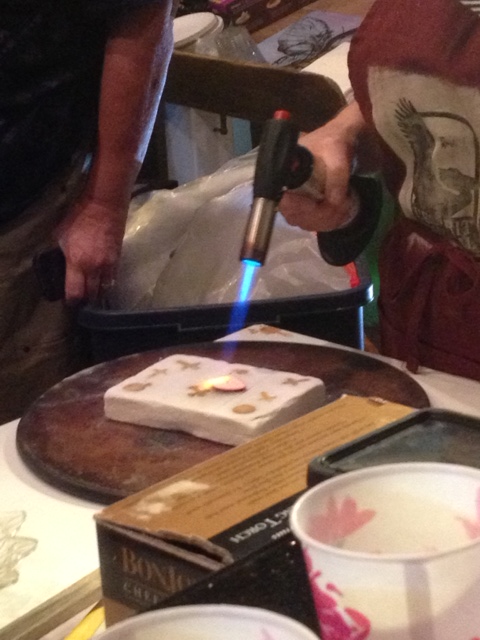
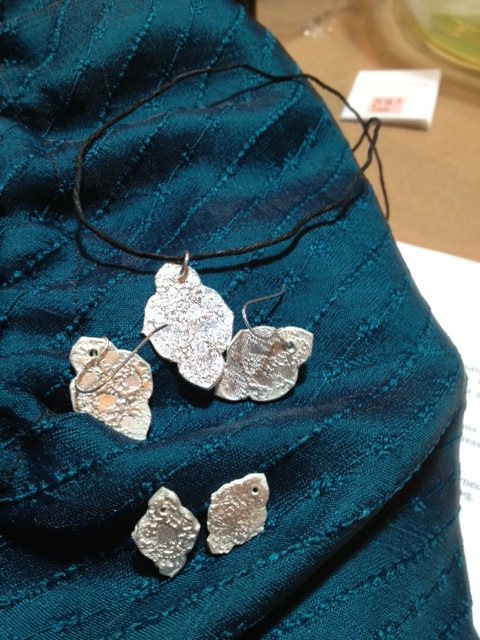
And tonight I attended a workshop for precious metal clay.  Actually, I already have some materials and tools, even a small tabletop kiln, and books for this.  I just hadn’t used them.  Tonight, though, I used 9 grams of precious metal clay (PMC 3) — silver — and made a pendant and two sets of earrings.  I rolled out the PMC3, textured it, and used a template to cut the different pieces out.  The class flew by.  The teacher demonstrated everything, talked to us all the time.  As we worked and had questions, she’d answer.  She’d walk around and help.  We used a dehydrator to dry our pieces leather-hard.  Then we watched as she used a creme brûlée torch to fire the demonstration piece.  After that, we each had to torch one of our pieces.  It was so much fun to watch the piece turn salmon color.  Once it was done, we immediately immersed the piece in water, and it was cool enough to work with immediately.  A brass wire brush was the next thing we used on that piece.  This is when the magic happened, and we watched as our pendant pieces emerged from the brushing as beautiful silver.  Absolutely fascinating.

Image

She took the rest of our pieces and fired them in the kiln.  When they were done, we polished them in the same way.

I left with a pendant and two sets of matching earrings.

Image

These aren’t perfect.  But what fun!  I am planning to work with my PMC3 clay on Saturday (day after tomorrow), and have no qualms now about using the torch.

And next weekend on Saturday,  I’ll be in the second PMC3 class — for 8 hours.  More advanced.  I’m already hoping that there will be a ring class.  And other classes.  It’s just addicting.

What a productive evening!

Before I’d left, I’d already posted photos on Facebook of my creations.  I’d already set a time to meet with my friend Myra, who is my jewelry buddy (we play together at least once a week and make jewelry) — we’re going to work with the PMC3 clay on Saturday, and then spend Saturday afternoon on wire and bead jewelry.

I knew that one day I’d get to spend more time with different crafts.  I just didn’t know what kinds.  There are more arts and crafts projects on my list than I ever imagined I’d want to do.  Stepping stones for my yard here and at the beach.  Slipcovers for chairs.  Recovering seat cushions on dining room chairs.  Tiling a backsplash.  Learning to knit (I now know how to make one kind of scarf).  Crocheting more.

Even when I was quite young, I loved to make things.  Visualizing a result was never my problem.  Imagination apparently came fully charged when I was born.  Maybe too much so, my parents might have said.

But having hobbies is a good thing for us.  If we work outside the home — whether in the classroom or an office or a store or whatever — it’s healthy for us to do other things.  Cooking, sewing, crafting, woodworking — you name it.  What a treat — you can immerse yourself in learning something, and use some spare time to create, to produce.

And depending on the craft, I often connect it with the person who taught me.  There are memories and histories as I work now.  And I’ve tried to pass on my knowledge — I taught my niece how to crochet.  We’ve done different crafts together — made mosaic-tiled coffeetables and end tables, tiled a backspash together.  It’s fun, and it’s our special time together.  She’s a graphic-arts major in college, and we don’t get to spend as much time together now.  But we have much in common.

Reading, of course, has always been my go-to passtime.  Playing the piano is something I do at times.  But beyond that — exploring different crafts and hobbies has been a passion of mine that I couldn’t always indulge.  Being able to, in whatever time frame, though, was beneficial — it balanced out the academic head work that has been my life.  Creativity in one area, I’ve found, sparks creativity in others.

When I took clay classes at McNeese and learned to throw on a wheel, to hand build, and to glaze and then watch what emerged, I found that my stress level dropped.  I didn’t have time to spend worrying or thinking — I had to be in the moment of throwing, of paying attention.  The clay wouldn’t center.  The pot or bowl or whatever just wouldn’t emerge.

I’d like to do more wheel work, to actually learn about glazes and how to run the kiln.  That’s on my list.

For now, I’m working on things at home.  My front bedroom has become my office.  My computer is here, angled off of my beautiful writing desk (thanks, Adam!).  I write here.

But behind me is the desk my brother Phil made me from a hollow-core door (that was what I used as a desk when I wrote my dissertation).  Phil took the door and put turned legs on it and trimmed it and then stained it.  My dissertation-door-desk is my jewelry crafting area.  On another wall is a bench with shelves.  This is for the small kiln — and for supplies connected with it.  Here is where I’ll do the precious metal clay work this weekend.  It’s where I can work with polymer clay.  There’s a small craft oven stored on a shelf — for polymer clay.  There are molds and texture sheets and other tools and supplies.  Most are neatly labeled now.

On another wall is a shelving unit that Dad made for me in high school.  It now holds all sorts of things — boxes for maps, for blank CDs, for some boxes.  And near it is a bookcase.  This is where the jewelry supplies go.  I have different boxes for glass beads, for gemstone beads, for pendant beads, for pendant cabochons, for gemstones (not beads), for findings.  One box is for base metal wire.  One holds different kinds of ribbon and necklace material.  A ring-binder notebook turned out to be a perfect way to organize my sterling silver wire and gold-filled wire.

This room is my new playroom.  It’s becoming itself — slowly, perhaps, but it’s emerging.  Organization is ongoing as I discover what I need where, and what works for me.

What works for me now?  This computer area.  And on Saturday?  The area for PMC3 — I’ll clear off the top tomorrow and get it ready for Saturday.  I’ll put out the supplies.  Get the butane and the torch ready, along with the brick to work on.

So far I’ve only worked with words and pens and computers, with materials and tools that twisted wire and closed it.

Now I get to play with fire too.  Watch out, world!

Categories: Uncategorized | Tags: , , , , , , , , , , , , , , | Leave a comment

If It’s Wednesday, It Must Be Duck Day

I confess.  It’s Wednesday, and that means tonight in a bit, I’ll turn television on and land on A&E for the evening.  It’s Duck Dynasty day.  I can get my fix of one of my secret pleasures.

Yes, I am a fan of Duck Dynasty.  Unlike other reality programs, this one has something that rings true to me.  I know that some people don’t like it; they see the Robertson clan as a bunch of dumb rednecks.  Well, I have to differ.  Rednecks?  Yes, as they are proud to say.  Dumb?  I don’t think so.

I’m sure that some of the storylines are scripted, to a degree.  But I don’t think that scripted lines sound quite so true if the people delivering them have no sense of their meaning.  For me, part of what is so funny about Duck Dynasty is that there is a bit of an edge, a dry wit that rings true.  These are not actors.

Okay, I know I have friends who will disagree.  I just don’t think they’re right.

These folks appear to me to be fully aware of the stereotypes that they’re plugged into by the show; they’re aware of those and use them.  It’s this self-awareness that sets them apart from other shows with rednecks, or hillbillies, or whatever stereotypes (especially rural ones) that are being exploited.

Their humor is quirky — and delivered with a sense of just how those lines will sound.

Having grown up in the same region, I must say that yes, I know people like this, who are proudly “country” and “redneck.”  Yet these are men and women who went to college, graduated, created and continue to run successful businesses.  That they also hunt and fish and (as Phil proclaims) “live off the land” is part of their lives.

They’ve lived real lives.  Phil and Kay married very young.  Their marriage survived Phil’s drinking days.  They’ve been poor.  They’re also not poor now.  Willie, the son who has become CEO, is clearly a really sharp businessman.  And his wife has been part of the success, as the wives of the other brothers involved in the business have been.

The brothers might live in much more exclusive neighborhoods, in much more expensive houses, than they grew up in.  But their core values, it appears, remain unchanged.  “God, family, guns.”  That’s how they revise the slogan usually attached to the show on posters and the like, rather than “Guns. . .”

Categories: Uncategorized | Tags: , , , , , , | 2 Comments

Tell Me the Story About. . .

When I was still teaching, I had a writing prompt that I used for any writing class– I’d ask students to write what their earliest memory was. From that, we’d talk about our answers and about the nature of memory. Did we really remember on our own, I’d ask, or did we “remember” because we’d heard about something for so long? Our discussions were wide-ranging and interesting.

The nature of memory has intrigued me for many years. In two families of storytellers, I grew up hearing family stories. Now that my parents and grandparents are dead, my sister and I often find ourselves wishing we had one more opportunity to ask questions of them. Just what would we hear? Would those stories confirm or refute what we ourselves remember?

Obviously, perspective makes a difference. I mean, my sister and I — though 7 years apart in age– experienced some of the same family events. Yet, if you talked to us, you might think we had not.

Recently, my cousin DD (her mother was my first cousin) has been eager to get together with me, my sister Kay, and her Aunt Carolyn (her late mother’s sister and my first cousin). She’s curious to hear more about her great-grandmother Ella (my maternal grandmother), my mother, and my family. Her grandmother (my mother’s sister) died a few years ago. That means, as Carolyn and I have discussed, that the two of us now are the “eldermothers.” We now are responsible for passing on the knowledge and the memories.

When my mother was alive, we could ask her about the same things her sister talked about, and by comparing their stories, we could analyze what happened or probably had happened. In our family, it was common to embellish stories, to soften stories, to invent — whether out of a desire to hide truth or embarrassment, who knows. My grandmother Ella was quite a colorful character — married four times and an independent businesswoman, her Irish/Cajun/Catholic family often found her both a rock and something of an embarrassment. To be fair, consider her time and its standards: she was born in 1908. Divorce was not common and was something to be ashamed of.

So sometimes the stories grew up to obfuscate the reality that was distasteful or embarrassing. Later, when times had changed and people regarded divorce and remarriage differently, it was easy to see the lingering condemnations of the past.

A common event, at various times, found one person pretending to be another (via a letter) in order to elicit information. The results, though, weren’t always what was anticipated. Thus my Aunt Dottie once pretended that she was my mother when she wrote to my mother’s biological father’s family — to let them know what they’d missed by never connecting with mother and her children. And my grandmother wrote to the Veteran’s Administration to get my biological grandfather’s WWI war record — only to discover that he had actually abandoned her (and my mother) rather than having disappeared and “died” (as his family continued to tell her). Grandmother was in her 70s at the time, and I think that broke her heart, even though she’d been 18 when that happened, and had married twice more and had a fine life.

Since part of our family’s heritage is Irish (my great-great-great-great grandfather immigrated to New Orleans in 1851), I sometimes refer to the “Irish-drama-queen” tendency in our family. Telling stories? Just as natural as breathing.

Sometimes Carolyn and I discuss what we grew up hearing. Between us, we try to re-construct a reality. Perhaps, though, it is just as correct to say that we construct a reality.

Only yesterday I was reading an article in the New York Times. As John Leland noted in that article, “Memory is a tricky thing: subjective, malleable to the needs of narrative or the fog of time. Some linguists believe that preliterate societies used myths to preserve their collective memories, and it seems possible, or at least poetic, that the style of memory is toward constructive story-making, not simple retention. We remember the stories we tell about our lives; we invent our lives in the remembering.”

Leland’s words struck me so much that I cut and pasted them into a note to myself. As a teacher of literature, I’ve always held with the notion that narrative is the most basic mode of writing. That urge to tell a story — our own stories, those of others, whatever — is perhaps intrinsic to human nature.

And long before we had written language, and thus written literature, we had oral traditions. History and literature and sacred texts were transmitted over time by word of mouth. Only later were they written down and even made standard.

As someone for whom Southern American literature was a speciality, I found myself responding to much of that literature with a kind of unconscious recognition. Thte patterns of speech and very narrative structures of Faulkner and Welty, among others, were part of what I knew from experience. The jump from my Granddaddy Ware’s front-porch stories to Southern authors’ short stories and novels was natural.

Stories could be repeated — and even were requested — as we’d sit there as time passed from day to evening. We knew what was coming, anticipated the known conclusion. Yet we continued to listen, to request, and to enjoy. The person telling the story might vary it to some degree each time, but the “truth” of the story didn’t.

My father, for example, could tell the same stories over and over, and each time was fresh. He’d pause at times, with what I came to recognize as a sense of timing. Whether that was conditioned and learned or inborn, I’ll never know. But I know that he could tell a story. Just as his father could. And other members of the family could and still do.

Soon I’ll meet cousins and my two aunts in East Texas for this year’s family reunion. There will be stories, believe me, many I’ve heard before. But I listen every year.

All too soon, I know, my generation will be the elders. WIll we be able to continue those family stories, those collective memories?

In part, I think, that’s why I write. It’s a way to process memories as well as to consciously construct a narrative. To re-create and to capture as well as to create.

Certainly I like to think it’s more than just my liking to “talk,” though Lord knows that’s true too. I can “talk” to the page as I talk to my cousins or to friends — but writing is more consciously constructed.

Passing our stories along becomes more important as we grow older, as we gradually become the elders of our families.

Trying to keep family units viable and active doesn’t mean being static. Stories of the past anchor us, help us know who we are, where we come from.

But family stories also reflect what we ourselves go through, what experiences we share. Telling those stories is equally important. Just as a family is a dynamic, changing entity (and as individuals we too are constantly evolving and growing), then our stories must grow, must add to the stories we inherit.

Soon I’ll be meeting with my cousin DD and Kay and Carolyn as we sift through family photographs and collectively capture the stories of my grandmother Ella and her family. Soon I’ll be joining my Ware and Richards cousins on the front porch of the farmhouse my Granddad Ware built.

Time to talk, to tell those stories, to consciously talk about what versions we know, and to make our own stories.

Some of those stories will be sad, to be sure, but many will be funny as well. We’ll learn new things and cement what we already know. There’ll be tears at times.

But there will also be laughter.

Can’t wait.

Categories: Uncategorized | Tags: , , , , , , | Leave a comment

Missing Dad

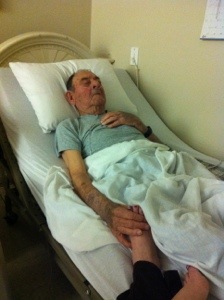
Recently I was reviewing some photographs on my desktop computer, trying to analyze how to control the thousands of digital photographs that I have. Before I knew it, one photograph simply stopped me and diverted my attention. It’s a simple photograph, one I took in the nursing home while Dad was in rehab.

If I were there for a period of time, I tended to pull a chair up close enough to Dad’s bed to rest my feet on it. He might be sleeping and I would be waiting for him to awaken. He might be resting, and I just followed suit.

This photograph is a selfie — one I took. Usually a selfie is of one’s own face; this is of my feet. Why? Because it captured such an ordinary moment that was very typical. Perhaps I was sensing just how short our time left together was to be, or perhaps I just thought it was a fun photo.

In any case, here’s the photo. Look at it. Then I’ll talk about it.

20130909-214252.jpg

For as long as I can recall, our family has been a very “touchy” family. We hugged a lot. We kissed a lot. We’d hold hands sometimes. One thing that was so typical of Dad is captured here in this photograph. If I were tired, and my feet hurt, he’d give me a foot-rub. With high arches, I find that my feet often ache.

Dad would do this for me, but also for Mother and Phil and Kay. After I moved in with Dad, I regularly gave him foot massages, especially useful the less he walked and the more bedbound he became.

Here, in this instance, I was just normally resting my feet while he was, I thought, sleeping. I was reading. Obviously, he felt the weight of my foot on the bed. Before I knew it, his hand had reached out to hold my foot. He was barely awake; his eyes weren’t even open. But that hand reached out to touch my foot.

How often we forget the power of touch, of contact. In the shared room he occupied in the skilled nursing unit of the nursing home, Dad must have felt irritated at times. I could tell. Sometimes he was really grouchy — to me. Rarely to the staff. Used to privacy and a measure of self-control, here he had neither, really.

At first he spent time reading. We had a television and cable hookup, but he seldom watched anything after a couple of weeks. I have photographs of him, with glasses on, reading a letter from my cousin Mike about some family farm business. He was sharp and interested. Within a few weeks, though, he was content to let me tell him about things. He didn’t read much.

He gradually withdrew more and more. His first week home from rehab was a good one. Though he didn’t read, he watched a bit of television, but lost interest quickly. He visited with our friends and neighbors who dropped by.

The second week, though, was a landslide downhill. Withdrawal into pain, into some other consciousness. He spent lots of time sleeping. He also spent time in pain. The pain meds never really did work well.

But the one thing that never changed: he loved for us to sit by him, to hold his hand. That human connection was still something he wanted, even to the end.

As he drifted in and out of sleep and consciousness, we’d sit by him, rub his forehead, stroke his face, his arms. We’d kiss him and tell him we loved him. No moments for such communication were lost. I know that I cherished every moment, and I’m certain that Kay did as well. Sensing how he was moving away from us, we took advantage of every moment, storing up memories that now have to last for the rest of lives.

We talked and laughed. We watched him turn inward more and more, sleep more and more, moan more.

That last weekend, I spent much time holding his arms, touching him. I had to. I was bandaging and re-bandaging his dialysis shunt, which kept bleeding. I changed sheets. I changed his clothes.

On Sunday we called in hospice, and finally the morphine helped, for a while. On Monday, with the help of hospice, I had to up the morphine in order to control his pain, which had ratcheted up again.

By the last day I hope he was aware of us holding him, even if that holding were meant to keep him from hurting himself. He talked to his mother, wanting to know if they could go home. He’d look right at me and talk to his mother. I answered him that “Yes, we can. It’s okay.”

Strange how that photograph has affected me. I’ve been a bit weepy on and off since then. Mainly, though, I’ve been sad, and melancholy. And grateful, too, for the kind of parents who were never ashamed to show us their love, to tell us that we were loved. More important, perhaps, their actions always embodied that love. Indeed, our larger family retains the kinds of connections we do not out of obligation but out of love and affection.

I’ve driven a lot lately. Maybe that’s one reason that tonight my feet hurt — the arches ache and I guess I’ll need to start taking my restless less syndrome medicine again for a while. That’ll have to do now.

I’d give anything right now if I could put my feet up for him to rub.

Categories: Uncategorized | Tags: , , | 3 Comments

Seriously Sirius XM

Satellite radio, I firmly believe, is Boomer Musak. Except with channels to choose from.

I’m relatively new to this version of radio. It came with the Prius (free for the first six months) and I recently renewed it via a good offer.

How did I not know it was possible to have entire channels dedicated to single performers? Pearl Jam. The Grateful Dead. Elvis.

One channel is Classic Rewind Rock. Another is Classic Vinyl Rock — I listened to that the other day for an hour or so, convinced that someone was channeling my memories of high school and college music, even early grad school. As I drove, I remembered barefoot dances in the grass to some of the tunes.

That’s when I realized that I had turned into one of those old farts. You know the ones. They don’t know who any contemporary singers or bands are. They rail about the decline of lyrics.

A similar moment occurred to me while I was reading People magazine a few days ago. Just who were all these so-called stars and celebrities? With a few exceptions, I was absolutely clueless.

No, I have clearly lost touch somewhere in the last couple of years. Maybe that came along with retirement. It’s not that I’m a curmudgeon. Not really. Or at least, I don’t think so.

Yet I’d prefer listening to nothing rather than listen to Kanye, or Rihanna, or Mariah. Give me a good NPR station. Or some of my own CDs. Or my iPod.

What can I say? I’m proudly Boomer in my music. The Stones are still performing. Crosby, Stills, and Nash will be playing at Neil Young’s fundraiser for learning disabilities. Fleetwood Mac were on tour recently.

Somehow, though, I think I’ll skip the upcoming tour of David Cassidy and Peter Noone (Herman’s Hermits). Their faces on the poster I saw today looked a bit too… refreshed.
They’ve had some cosmetic work done, or a really good air-brushed job.

So let me tune in to Van Morrison. The Beatles.

And while I may not sing in the shower, I guarantee that I sing along in the car. Loudly.

Jimmy Buffett–“God’s Own Drunk.” The Kinks’ “Lola.” Lynerd Skynerd. The Allman Brothers.

God, they don’t make music like that anymore.

Categories: Uncategorized | Tags: , , , | 1 Comment

Stormy Saturday


image

As I drove away from Lake Charles, I talked first to my sister and then to my friend Martha — hands free, thanks to the Bluetooth connection in my car. Before I knew it, I was on Highway 173, over the Rainbow Bridge, and on my way to Winnie.

With the Gulf of Mexico right off to my left, I was on my way yet again to Crystal Beach. That’s when I noticed the storm clouds over the Gulf. Just lovely.

Actually, they were quite lovely. I mean that. There’s a beauty in the play of dark and light, of shadows. In this case, in shades of gray (not 50, not that best-selling mommy porn book). There was the blue-gray of the sky, with lighter streaks. There was a dark gray column cutting through the sky itself, anchoring the darker gray rolling clouds above to the Gulf. Within the dark gray, there were ripples and curls. Lighter areas dotted the dark gray. Truly, it was beautiful.

It was also more than threatening rain. Though a full thundershower never developed, I did get a few sprinkles of rain. Once I’d turned at Winnie toward High Island, though, the rain came. Again, not in a lasting thunderstorm, but in a strong short shower. I drove up to and over the Intracoastal Canal bridge in the rain, and then was at High Island, and the rain cleared.

By the time I turned onto Highway 87 for the last stretch of driving, the sky was actually clear over the Gulf. My last fifteen minutes to the house were clear of rain. I parked, unloaded the dogs and my overnight bag, walked upstairs, unlocked the door, and sighed. Once I’d put water and food down for the dogs and turned on the AC, I left. Headed to Galveston. Time for Target.

I had no wait for the ferry at all. But that also meant waiting for the cars behind me to fill up the ferry. When the ferry starts to head out, it’s only a 15-minute ride to the island. Not long at all. But even with the windows in the car rolled down, it was steamy and hot, and soon I had the sweat-sheen that everyone else had. Oh well. It’s still summertime here, despite what the calendar might say.

Driving off the ferry, I bypassed the turn to the Strand, instead heading to Broadway, which leads to I-45. The shopping center I wanted is right there, just to the right. Today I was heading to Target. Surely, I thought, I’d find a number of things on my list for the house.

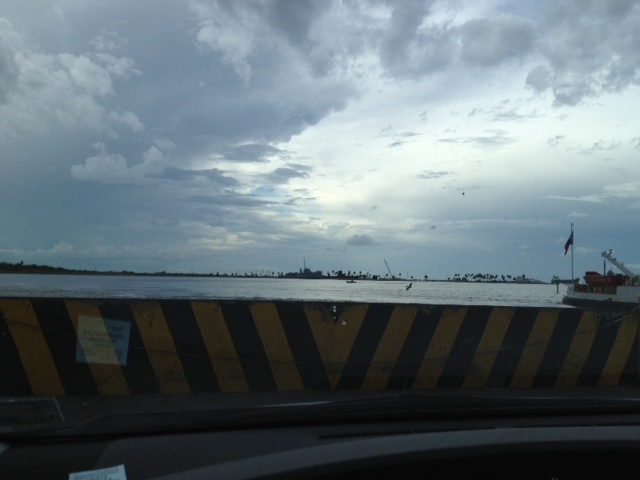
Nope. Not today. Maybe the shopping gods weren’t paying attention. So with my few purchases, it was time to head home. This time, I was in line for the ferry. It wasn’t as bad a wait as it can be, though, and soon I was directed to drive on. I ended up being one of the first cars, with a clear view of the ferry gate and the Gulf.

image

Once more, I rolled the windows down. This time, I simply sat and observed the sky once more. Darker blue-gray clouds edged with lighter gray areas swirled around a clear opening in the middle. Light streamed through it, trailing off to the right. More storm clouds, I thought.

Within a minute, the clear area in front of me filled with people getting out of their cars to stand at the front of the ferry for the ride to Bolivar Peninsula. I stayed inside my car, reading.


By the time we approached the peninsula, skies were clear and blue, and the lighthouse clearly marked the peninsula itself.


image

Once off the ferry, I drove to the Gulf Coast Market, needing a few more items. Then it was home, up the stairs, and into the house. The dogs greeted me as though I’d been away for weeks.

Now I’ve read a bit, eaten, and am ready for bed. The storms never really arrived. In a way, I’m sad about that. I love being safe and snug in a bed, under a quilt with a good book, when it’s raining. The sound of the rain soothes me and lulls me to sleep.

Not tonight, though. I’ll just have to wait for another storm to actually develop another time.

Maybe I’ll dream about rain.

Note on Sunday morning: Technical difficulties last night meant that I couldn’t upload this until now. No good cellular connections means no uploading.

Categories: Uncategorized | Tags: , , , , , , , | Leave a comment

Blog at WordPress.com.