
Since today is National Dog Day, I’ve spent a few hours thinking about my two dogs, Gypsy and Zsa Zsa, to be sure, but also about all the dogs in my life. And about Dad. Because it’s all his fault, really, my life-long attachment to dogs.
I don’t ever remember life without dogs. When I was six months old, Dad got transferred from Beaumont to Humble, a small town near Houston. Before too long, he’d gone hunting with a neighbor of ours who had a young female pointer. The dog really took to Dad, but when Mr. McIlvoy tried to give her to Dad, Dad refused; he couldn’t afford to buy the dog, and he wasn’t going to take her as a gift. Sly Mr. McIlvoy got around that by giving the dog to me. So Kate came to live with us and my love affair with dogs began.
Kate and I bonded, no doubt. If Dad or Mother wondered where I was, all they had to do was say my name and Kate would take off to find me. I could sit on her, pelt her with toys — you name it, and she simply stood there with me. When I was maybe two, my Dad loved to tell friends (anyone who’d listen, really) about the time he found the two of us sitting on the back steps of our house, the dog food bag at my feet. I’d pick out the nugget for her and then a flake for me. He figured if it was okay for the dog, it wouldn’t hurt me either.
He loved that dog, and until the end of his life swore that she was the brightest dog, the best pointer, he ever had. And the best tempered. Even with a string of dogs that followed, none ever quite matched up with Kate.
All of the dogs loved Dad, doted on him. He was a good, patient trainer (and I suspect that was true with us kids as well as dogs). Dad loved to hunt quail in particular, and that’s why pointers were so common around our house. He also hunted ducks and teal. And squirrels. And deer. He just didn’t need dogs for everything he hunted.
He had a tender heart and couldn’t stand to see injured animals of any kind. Dad would bring injured animals home and nurse them. That’s how I got Jimmy the Crow.
When we had two dogs poisoned a couple of weeks apart, a dachshund and a pointer, both kept penned and not loose, I think that was the first time I’d ever seen Dad so worked up. That someone (who probably knew us) had chosen to come to our house — in the camp in Egan — two weeks apart and poison two of our dogs was just something without excuse. I think there were over 10 dogs poisoned in Egan in that period. One of ours survived. The other didn’t. Dad never got over the fact that someone was sick enough to poison a helpless dog.
When I was a freshman in college, we were visiting Dad’s brother and family in Longview, Texas. On our walk in the neighborhood, my cousin Barbara and I came across a puppy that had been thrown out and abandoned. It was so young it’s eyes weren’t open. I picked it up and brought it home, and she swore Dad wouldn’t let me keep it. He sat down in the floor with me, cuddled it, and showed me how to feed it. We kept that dog for the few years he was alive.
After Kate, we had other dogs. We had one of Kate’s only two pups, but she got run over by a truck. There were other pointers. There were a couple of small non-hunting dogs. Dad’s last hunting dog was really my brother’s dog. I was living here in Lake Charles when Phil came to pick me up one day. He’d found a dog to buy, one he wanted for Dad. A young pointer with a field-dog pedigree. And so Buck came to live in Egan.
Buck was sweet. He just wasn’t the brightest. Nor did he ever really hunt. He was shy of loud noises, which didn’t bode well for a hunting dog. Buck would point — beautifully, really — just perfect form. But the problem? He’d go on point for anything. I watched him go on point for butterflies, for frogs, for almost anything that moved. Once he actually got the frog, and then didn’t know what to do with it.
Despite the fact that Phil bought Buck for Dad, Dad always called him Phil’s. Even when Phil moved to Florida, Buck was still “Phil’s dog.” Yet Buck lived in Dad’s back yard in Egan. We’d pet him, get in the pen sometimes to play with him. He didn’t like some strangers, though — and someone we knew apparently hit him once, and when that person would come around, Buck would slink down and his ears would pin back. He really didn’t like that person, who just thought it was funny and would antagonize Buck by rattling noisy things on the fence. But Buck loved women. All of us.
It was strange, really. about Buck. The day that Phil died, Buck (who’d was old by then and very frail) couldn’t walk and was falling over. Dad had to take him to the vet to be put down. We cried a lot that day.
Though Dad didn’t bird hunt for years, he still loved “bird dogs,” short-haired pointers in particular. Really, though, if it was a dog, and friendly, it headed to Dad. And he loved to tell stories about dogs and hunting. He loved to watch field trials on television. He and my cousin Jim (who also hunts, but has had retrievers) could talk about hunting and dogs. Dad could always talk to someone and pay attention to a dog at the same time, as evidenced in the following photograph I took at Jim’s house in Galveston.
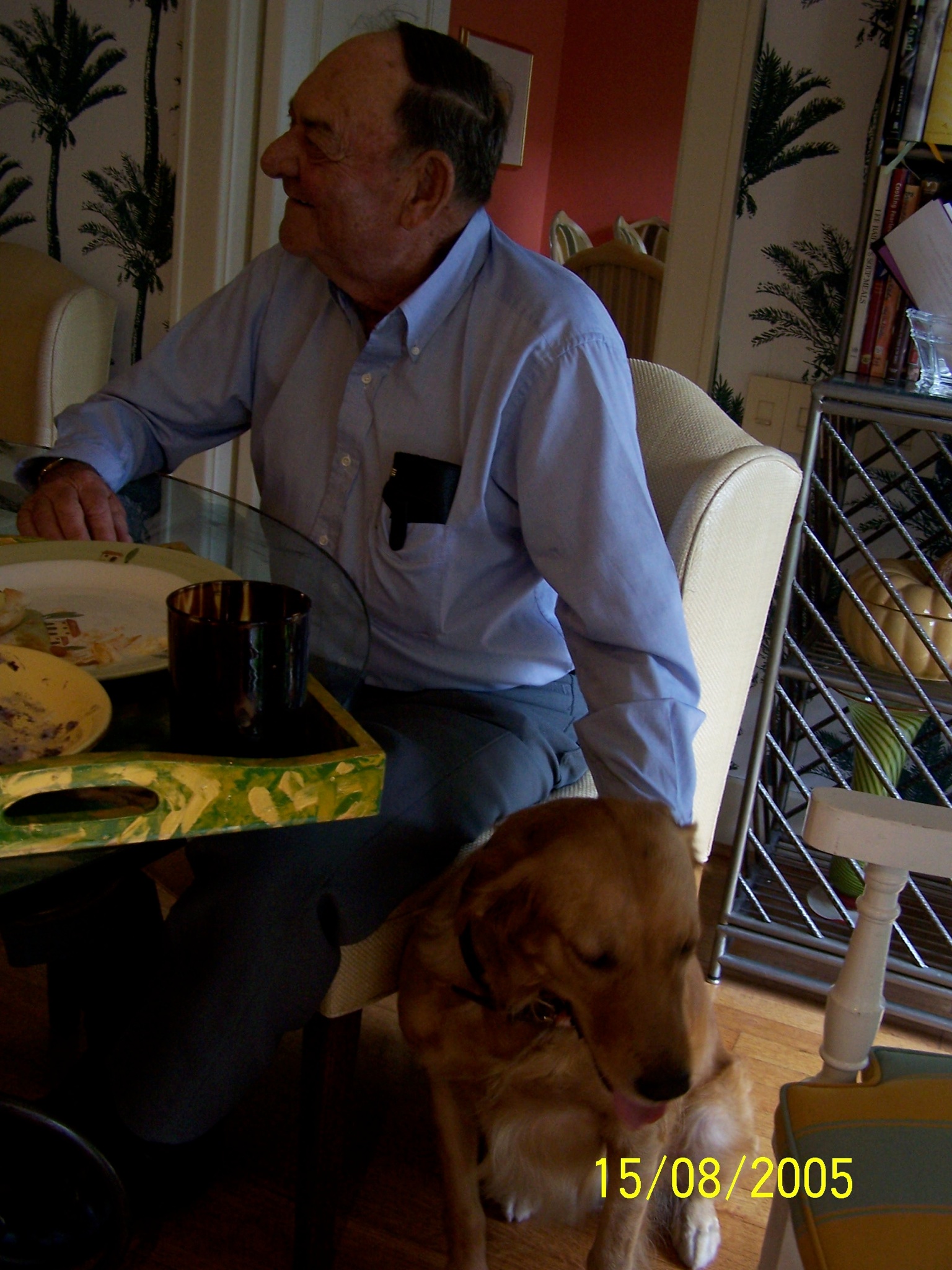 Dad and Dixie
On my own since my 20s, I began acquiring my own dogs, but small ones because I lived in an apartment at first, and also because I had an erratic teaching schedule. First came Punkin, a poodle-chihuahua mix. Punkin was a treat — sharp and bright and funny. Then I had Scarlett, my first Shih Tzu. Soon after, I got a second dog, Rocky, a Shih Tzu mix. Rocky was cute and sweet, but not really bright. After them, I was hooked on Shih Tzus. It just seemed destined.
After Scarlett and Rocky died, I took in a stray that my cousin’s wife found in Galveston — a black and white Shih Tzu. My niece Rachel announced that this little dog (I named her Zoe) was like Scarlett and Rocky had come back in one dog. And that was true — she looked like them, even had some shared traits.
Another stray came home with my from Krogers one day; I’d stopped her from being run over in the parking lot, and she jumped in my car and claimed me. So Scruffy added herself to my menagerie.
Hurricane Rita was hard on many animals, even animals that were safe and secure. The stress was so great that many became ill and died shortly after the storm. That was the case for Scruffy and Zoe and my cats. Within six months, I was left with one pet, and that cat died too within a year.
But I couldn’t live pet-less. First I got Zsa Zsa from a friend whose dog had had a litter. Then came Callie, a calico cat. Soon after, my sister Kay found a stray Shih Tzu in Natchitoches, and when the pup’s owners decided they couldn’t keep her, she came to live with me. They’d named her Princess Sugar Cokie (I swear), but I could not stand that name. Gypsy seemed a more appropriate name for her because she was an escape artist and liked to roam. Now one of the young girls at my vet’s office laughs and tells me that my dogs have stripper names. Oh well.
So then I was back to three pets, a cat, a Shih Tzu and a Shih Tzu mix. Before I knew it, I was taking in a male kitten from Dad’s garage, a black and white sweetie I named Romeo. And finally, on Spetses a few years ago, a tiny kitten adopted me and hitched a ride back to Lake Charles from Greece. I named her Homer.
I’ve grown to like cats, but I’m really a dog girl at heart.
If I weren’t careful, I’d be overrun with stray dogs and cats. I watched Dad take some in and nurse them back to health. I learned from him that pedigrees weren’t that important in the long run.
Regardless, his favorite dogs remained pointers. Mine? Shih Tzus have stolen my heart. They are bright and sweet, strong-willed, and love to snuggle. They have distinct personalities.
Dad would joke about my little fur-balls being “worthless,” but he always said that with a grin as he was petting them.
 Dad, Scruffy, and Zoe
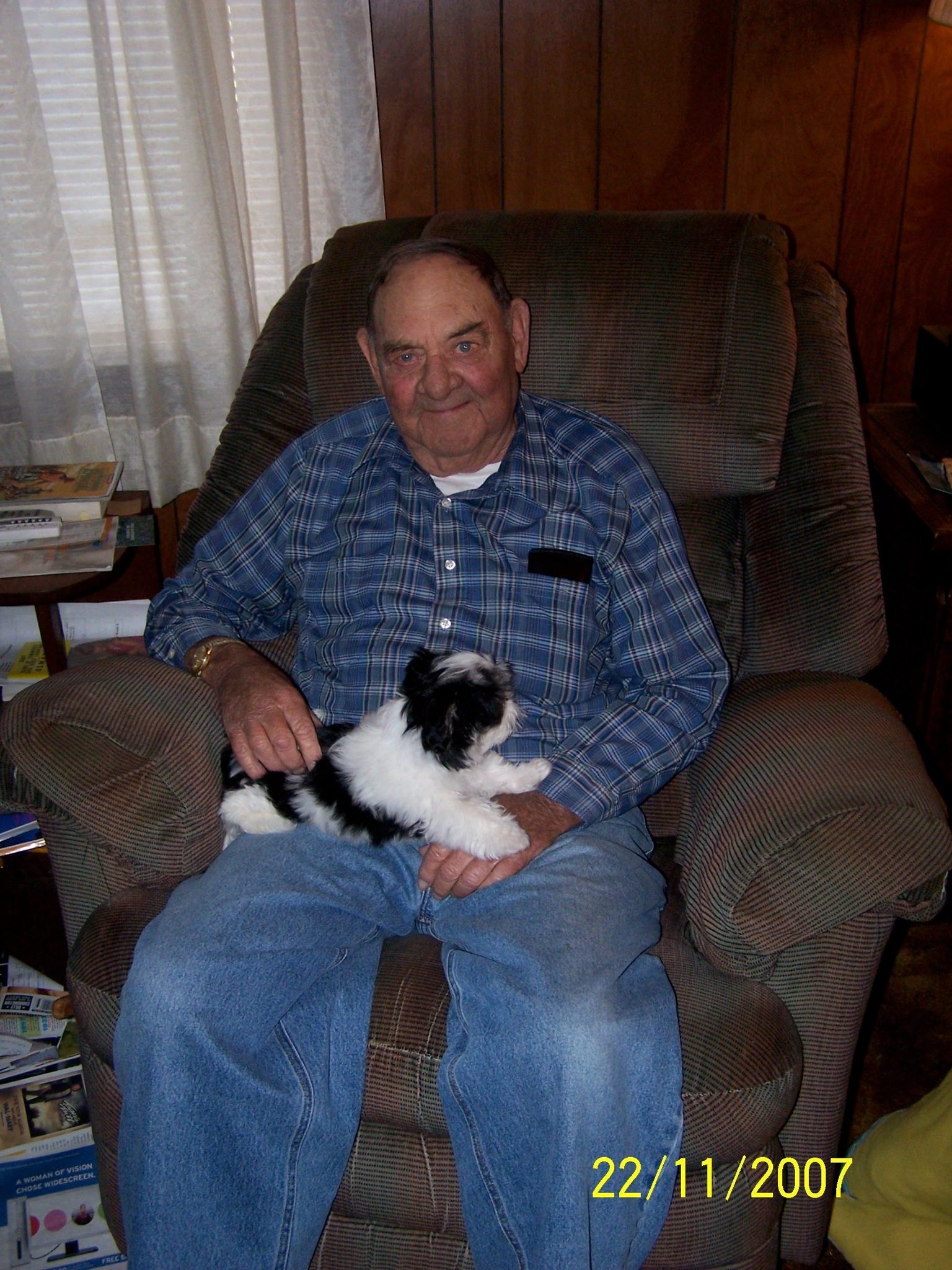 Dad and Zsa Zsa
Dad’s love of animals was evident to everyone. My friend Tom Fox once heard Dad tell stories about dogs, and Dad was a great storyteller with an amazing sense of timing. Tom said he’d listen to Dad talk about dogs anytime, and he didn’t really know much about dogs, or like them, or hunt, but it didn’t matter — Dad had him.
Dad let me do things I can’t imagine many other dads would: when we lived in the camp in Egan, I can remember sneaking out the back door at night when I was maybe 8 and bringing Kate in to sleep with me. I know he must have heard me opening the door, going outside, and bringing Kate in. I had to unlock the gate to the dog pen, too, and close it. I’d bring Kate in, make her get in bed with me, and go to sleep. He’d let me get away with it.
From watching Dad, I learned about how to care for a pet, how to be a responsible owner. He didn’t have to tell me much — he showed me, through his own actions. And dogs always recognized that he cared about them. They gravitated to him. His face would soften into a smile and his voice would drop as he talked to them; his hands were stroking their heads, scratching their ears. They knew a dog person when they saw one.
Treated properly, dogs are wonderful companions. They have love and loyalty, unconditional love. They sense their owners’ emotions. I know mine certainly do — when I’m down they sense it and crowd me as though to reassure me I’m loved. They lick me. A lot.
They’re good for us, too, studies show. Blood pressures drop when people are petting dogs and cats. Many nursing homes now allow therapy pets in so that their residents can benefit from petting a dog. Some dogs, it appears, can even sniff out tumors.
Yes, they can be trouble to care for. Pets mean that you have to consider their care before you can simply hit the road for a trip.
They’ll miss you when you’re gone. They may make you pay when you return, but not for too long.
Treat them right — and you have companions that lavish love.
The dogs and cats I have now are the last pets I’ll have that Dad knew. That makes me sad today, to tell the truth.
But that I love my dogs — that I can’t see living without one — is one of his many legacies to me. Thanks, Dad, on this National Dog Day.
Now it’s time to pay some attention to Zsa Zsa and Gypsy, who wait for me.

 cwareintheworld